
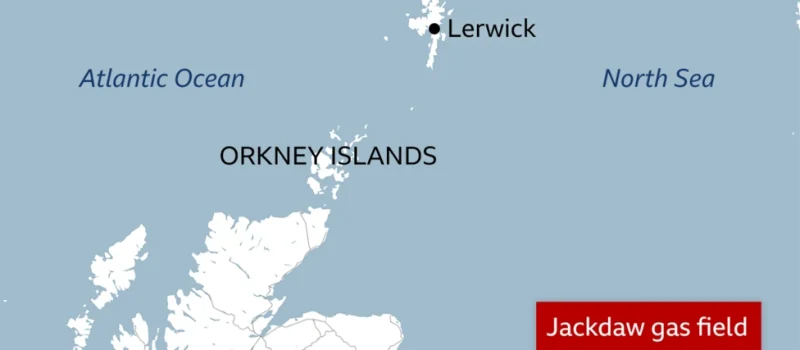
Two big talking points have dominated climate politics in the UK this summer: whether the new PM should authorise exploitation of the Rosebank (oil) and Jackdaw (gas) fields in the North Sea and what the country should be doing to better cope with summer heatwaves and drought.
These topics were also in the air 50 years ago. I experienced the hot and dry summer of 1976 as a 16-year-old living in St. Andrews, Scotland, and two of the talking points that summer were similar: what to do about drought—water rationing was being mooted and a Minister for Drought was appointed—and a lively debate about the future of ‘Scotland’s oil’, which helped trigger the 1979 referendum on Scottish independence.
The difference was that in 1976, no one was making any connection between the two issues
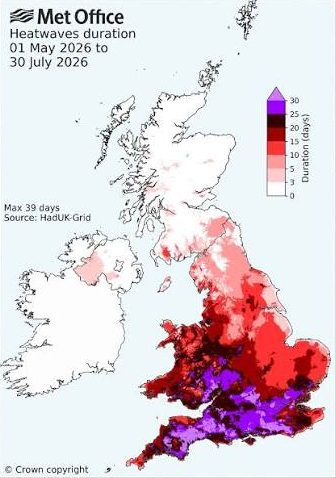
This summer, however, some climate campaigners and some public commentators have interwoven the two talking points. The line being taken by some has been that stopping new North Sea oil and gas extraction is necessary to avoid repeats of the hot summer of 2026 in England and Wales (it should be noted that Northern Ireland and Scotland have had rather mild and wet summers).
For example, Tessa Khan, executive director of the campaign group Uplift argued “It would be a huge betrayal of the British public for the UK government to approve new oil and gas fields at a time when ordinary people are suffering so much as a result of these record-breaking heatwaves.” And the pressure group, #StopRosebank, uses the headline “If we want a liveable climate, we can’t allow any new oil and gas projects or licences.”
But this thinking is wrong.
Perpetuating North Sea oil and gas is controversial because it would seem to undermine the UK’s net-zero ambitions—a largely carbon-free electricity network by 2030, an 87 per cent reduction in national greenhouse gas emissions by 2040 and achieving overall net-zero emissions by 2050. Some people defend these targets on the ground that the UK must play its part in achieving the global warming targets laid out in the 2015 Paris Agreement; others, because they believe them necessary to help the world avoid catastrophic climate change.
The future of North Sea oil and gas and coping with summer heat and drought are both important political questions. But whether or not the UK continues to exploit the oil and gas remaining in North Sea fields will make no discernible difference to the future of heatwaves and droughts in the country. Doing one thing—limiting future North Sea oil and gas production—will have no effect on the other—minimising the future frequency and intensity of hot weather.
Before I explain further let me be clear. Human activities have been changing the world’s climate over several generations, a change we have seen accelerate over the past 50 years. These changes have occurred primarily through the effects of global emissions of greenhouse gases and aerosols resulting from fossil fuel burning and changes in land use. These changes to the global atmosphere have affected the UK’s climate. Twenty-five years ago I co-ordinated the work for the UK Government which created a series of climate scenarios, published in 1996, 1998, and 2002. This pointed out clearly that human-induced changes in global climate will make UK summers hotter and drier—on average and over time. We will experience summer heatwaves more often and they will likely become more intense.
Let me also be clear in saying that the more carbon dioxide (and other greenhouse gases) the world emits into and leaves in the global atmosphere (and, importantly, the more effective we are at reducing emissions of aerosols) the hotter the planet becomes. And the hotter the planet becomes, the more likely will be further disruptions to historical climate patterns around the world. These disruptions will not be the same everywhere, but their effects will be felt everywhere.
That said, there are two reasons why it is wrong to connect decisions about North Sea oil and gas with those about managing summer heat. The first is that the UK has always experienced heatwaves and summer droughts and always will. The summer of 1976 is an obvious precedent, but there are others in the historic past, for example 1947, 1911, 1846. Such seasonal extremes always leave their marks on society, whether through fires, crop yields, economic losses, excess death rates and so on.
Second, it is the rise in global emissions of carbon dioxide (and other greenhouse gases) that affect the path of the world’s climate; it is not the future emissions from a country such as the UK. The country’s carbon emissions are now only 0.8 per cent of the present global total, down from 2.6 per cent in 1990 and still falling as a percentage. If the country’s emissions dropped to zero tomorrow, the effect of this on future global climate, and hence on UK climate, would be unnoticeable against a background of natural weather variability and ongoing climatic change caused by historical emissions combined with the other 99.2 per cent of ongoing global emissions.
It is therefore wrong to force these two (important) political issues to be dependent on each other. Decisions about North Sea drilling and decisions about adapting the country to cope with summer heat need to be made against different sets of criteria.
Thus, questions about the future of North Sea oil and gas need to be answered using a wider set of criteria than simply achieving the UK goal of net-zero by 2050 or, even worse, on the grounds that we need to minimise the frequency and impact of future UK heat and drought. Other important criteria include, for example, energy (and national) security, energy pricing, effect on jobs and communities, as well as how UK chooses to position itself in relation to international climate agreements. But we shouldn’t think that the choice made will somehow either ‘worsen’ or ‘improve’ future occurrences of heat and drought in the UK.
And the question about how best to cope with summer heat and drought need treating as just that: how should the country better manage the impacts and disruptions that come from such weather extremes. This entails, among other things, revising existing or developing new management plans, building new reservoirs, re-wetting landscapes, introducing air conditioning technologies, working with new, smart building materials, urban greening, adjusting working practices, changing agricultural cropping patterns or introducing new genetically engineered seed varieties.
Answering both these questions involves judgements about the allocation and re-distribution of resources. These will affect different stakeholders in different ways and so the judgements made will of course be deeply political. But people should be allowed to arrive at different answers to these questions without being labelled irrational or else either a climate denier or a climate alarmist. We need to learn to disagree well.
What shouldn’t be done is to claim that we need to close down North Sea oil and gas to make future heatwaves more manageable. Heatwaves will continue to occur whatever decisions are made about Rosebank and Jackdaw. In fact, given the trajectory of the world’s greenhouse gas emissions, heatwaves will probably get more frequent and extreme whatever decision is made.
Equally, don’t include closing down North Sea oil and gas as one of the management strategies for dealing with hot weather. There are many ways of adjusting the country to hotter weather and shutting off North Sea oil and gas extraction nis not one of them.
© Mike Hulme, University of Cambridge, 24 August 2026