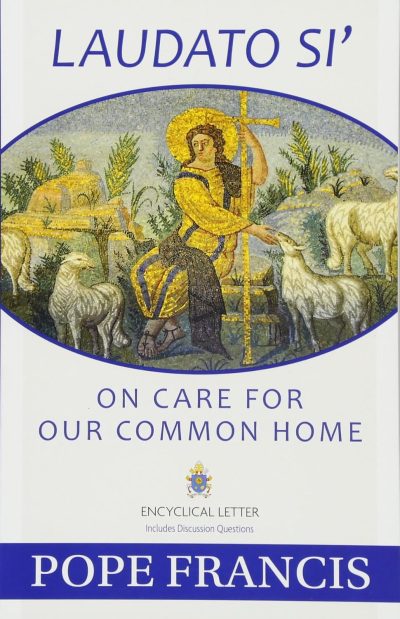
Pope Francis, ‘Laudato Si’: On Care For Our Common Home’ (Brooklyn, NY: Melville House Publishing. 165pp.)
1 September 2026. This is roughly an 8 minute read
This essay continues my series of monthly posts in which I select one ‘climate’ book to highlight and review from one of the 44 years of my professional career in climate research (starting with 1984, my first year of academic employment). The series will end in September 2027, the month in which I shall retire. See here for more information about the rational for this series, and the criteria I have used in selecting my highlighted books.
This ‘2015 essay’ can be download as a pdf.
At 7:08pm, on Wednesday 13 March 2013, the tens of thousands of people who had gathered in St Peter’s Square in Rome started cheering loudly as white smoke mushroomed out of the specially installed chimney protruding from the roof of the Sistine Chapel. The smoke signalled to the crowds below, and to the world at large, that the 115 Cardinal Electors had chosen the 266th Pope, the latest successor in the line extending back nearly two thousand years to St. Peter, an apostle of Christ. The Roman Catholic Church had elected Cardinal Jorge Mario Bergoglio to be the world’s most influential religious leader.
Bergoglio (1936-2025) was born and raised in Buenos Aires, Argentina, to Italian parents. He joined the Jesuits in 1958 and progressed through the ranks of the Catholic Church, being created cardinal in 2001 by Pope Jean Paul II. It is the tradition that Popes are allowed choose their own signature name and Bergoglio chose ‘Francis’, in honour of Saint Francis of Assisi. St. Francis had founded the Franciscan Order of Friars in 1209 and was known for renouncing wealth and living in poverty, an example which he had followed. For example, while a bishop in Argentina, he’d chosen to live in his own apartment outside Buenos Aires rather than in the bishop’s palace.
Choosing one of Italy’s patron saints also tied him to Italy, the homeland of most popes over the centuries, as well being the country the Bergoglios were originally from. But Bergoglio’s choice also gestured towards St. Francis’ patronage of animals and the environment. St. Francis saw God reflected in the natural world and in his ‘Canticle of the Sun’ he gave God thanks for “Brother Sun, Sister Moon, Brother Wind, Water, Fire and Earth.” Furthermore, in 1979, Bergoglio’s predecessor but one, Pope John Paul II, had declared Francis the patron saint of ecology.
Having signalled his priorities through his choice of papal name, two years into his term of office, in 2015, Pope Francis signed-off his papal encyclical Laudato Si’—the Italian for ‘Praise be to you’ and taken from St. Francis’ ‘Canticle of the Sun’. The encyclical was subtitled ‘On care for our common home’ and was his call for “a new dialogue about how we are shaping the future of our planet.” This was Pope Francis’ second encyclical, but the first that was entirely his initiative. Laudato Si’ had been anticipated for several months previously—eagerly by many Roman Catholic Christians and with much curiosity by those outside the Church working on issues connected to climate and environment. After being signed off by the Pope on 24 May 2015, Laudato Si’ was publicly released a few weeks later, on 18 June. I have therefore selected ‘Laudato Si’: On Care For Our Common Home’ as my 2015 Climate Book of the Year.
The reach of the Catholic Church around the world meant that Laudato Si’ would prove to be a climate change publishing event on a par with the release of a new IPCC science report or of the 2006 Stern Review on the economics of climate change. Laudato Si’ received extensive coverage in both the news media and the academic world. As noted by a Catholic communication specialist a few years later,
Few Church documents gain the attention of those outside the religious press; even ‘newspapers of record’ offer little beyond notice of publication. Laudato Si’ proved different. Its topic attracted wide interest, and the Vatican’s news and information office increased news coverage by a press conference.[1]
The publicity the encyclical received was also aided by its timing. Towards the end of 2015 the UN’s Paris Climate Conference, COP21, would take place, at which it was planned a new climate treaty would be agreed. This context furthered worldwide interest in the document, reinforced by Pope Francis’ personal popularity.
Expectations were high all round. In a Preface written for the Melville House Publishing edition of Laudato Si’, the American historian of science, Naomi Oreskes, described the document as “a call to action that insists we embrace the moral dimensions of problems that have heretofore been viewed primarily as scientific, technological and economic”. [p.vii] She regarded the encyclical as significant as the publication of Harriet Beecher Stowe’s ‘Uncle Tom’s Cabin’ in 1852 and Rachel Carson’s ‘Silent Spring’ in 1962 as historical turning points in, respectively, black emancipation and environmental awareness. And on the day of Laudato Si’s publication, the NY Times ran a story headlined, ‘Pope Francis Aligns Himself With Mainstream Science on Climate.’ It described the encyclical as “a ringing call to action, a critique of consumerism and a prophetic warning about the dangers of ignoring what Pope Francis calls ‘the ecological crisis.’”
The origins of Pope Francis’ encyclical can be traced back to a meeting held under the auspices of WWF International in 1986 in Assisi, Italy, the birthplace of the St. Francis. It was the first ever meeting between major international environmental groups and leaders from five of the world’s major faith traditions, including Pope John Paul II from the Roman Catholic Church. The Assisi meeting had been the idea of WWF International’s president at the time, HRH Prince Philip, Duke of Edinburgh. He’d wanted to challenge, provoke, assist and encourage the major faiths to take seriously the threats to the global environment. Nearly 30 years later, this faith-based environmentalism appealed to Pope Francis and shortly after his election he asked the Pontifical Academy of Sciences and the Academy for Social Sciences to convene a joint workshop on the theme ‘Sustainable Humanity, Sustainable Nature: Our Responsibility.’ The meeting took place from 2-6 May 2014 at Casina Pio VI in the Vatican Gardens, attended by a wide range of climate scientists. It was to inform the Pope’s preparation of Laudato Si’.
What the Pope offered in his encyclical was a powerful story—a meta-narrative—about the human condition. It wove together concerns about technology, water, power, climate, slavery, biodiversity, and greed into an inspirational account of divine goodness and healthy human living, drawing firmly upon Catholic theology and social teaching. Laudato Si’ escaped the narrow confines of a scientific or economic approach to climate change and showed the relevance, vitality, and inspiration of a Christian worldview. It also drew attention to the centrality of the idea of personal transformation in the Christian faith.
A Papal encyclical is a letter written by a Pope primarily for an audience of bishops with the intention of guiding them in their ministry. But encyclicals are also intended for the spiritual benefit of all the people of God and for all people of good will. The generally positive reception to Laudato Si’, by secularists as well as by believers, was perhaps partly because many were looking for a different source of authority than science for motivating people and politicians to pay attention. IPCC assessment reports are sometimes referred to metaphorically as ‘the Bible of climate change’, the authoritative (but not final) word of science. But in the anticipation of a Papal encyclical on climate change there was a sense among many that where science and the IPCC had ‘failed’, religion and the Pope might ‘succeed’.
In this respect, the response of Professor John Schellnhuber, a great champion for climate science, was instructive. In the story in the New York Times that ran on 18 June 2015 he was quoted: “One of the hard lesson scientists have learned in recent years, Dr. Schellnhuber said, is that presenting the facts and data about global warming and other environmental problems has not been enough to move the public to action. The issues have become so serious that only a broad moral awakening can offer hope of solving them.”[2]
The scholarly world, the world of research, also picked up on this sentiment. Several journals commissioned special issues to bring forward a range of commentaries on the encyclical written by distinguished scholars. The collection published by Environmental Humanities gives a flavour of these. Here, Matthew Chrulew wrote about ‘Pope Francis’s planetary practice’, Celia Deane-Drummond about ‘Pope Francis: Priest and prophet in the Anthropocene’, and the well-known French critical theorist, and Roman Catholic, Bruno Latour about ‘The immense cry channelled by Pope Francis.’
In many senses, Laudato Si’ was a global phenomenon. It obviously drew the attention of the world’s 1.2 billion Catholics and generated intense interest within the Catholic Church and amongst Christians more broadly, and indeed among other faith traditions. But it did much more than this. Its meta-narrative about climate change seeded a new movement, new networks, institutions and resources. For example, a film version of the encyclical was released in 2022—‘The Letter: A Message for our Earth.’ The organiser of the 1986 WWF meeting in Assisi, Martin Palmer, stated in the film, “There has never been an invitation from the Pope to the rest of the religious world and the secular world to become partners side by side in addressing a major issue. That is unique. That’s the turning point.” [at 43:47]
But was Laudato Si’ a turning point? Did it change people’s minds about climate change? Following its publication in 2015, a huge research literature emerged which sought to track the impact of the encyclical on public attitudes towards climate change. In one of the most comprehensive studies, published in 2022, a group of scholars surveyed 150 English-language publications between 2015 and 2020 which investigated the impacts of Laudato Si’.[3] The authors noted that even though only 10 percent of these studies were critical of the significance and vision of the encyclical, they concluded that it had, at most, a variable impact. For some people, they wrote, the encyclical “has not only led to increased credibility of the Pope but also [to] increased concern for climate change, whereas for others it has led to a decreased credibility of the Pope as well as a lessened concern for climate change.” The authors recognised, however, that these 150 studies were largely focused on the US and Europe while neglecting other regions, especially Africa.
Laudato Si’ spawned new initiatives, both within the mainstream Catholic Church and among others more loosely associated with Catholicism but taking inspiration from the Pope’s message on climate. For example, the European Laudato Si’ Alliance (ELSiA) was a network formed in 2019 of seven Catholic organisations with the goal of bringing the encyclical letter to life.[4] Rooted in the social ethical teaching of the Church, ELSiA was a Catholic Alliance promoting climate justice. Another institute taking its inspiration from Laudato Si’ is the Laudato Si’ Institute at Campion Hall, Oxford. Founded in October 2019, the Institute “provides intellectual foundations for a reordering of society toward care for the earth and care for the poor, inspired by Pope Francis’ encyclical.” It adopts the distinctive approach to climate and ecological research promoted by Laudato Si’, the idea of integral ecology.
In 2023, eight years after Laudato Si’s publication, Pope Francis returned to his theme. In an address delivered at the Basilica of Saint John Lateran in Rome, on 4 October, the Feast of Saint Francis of Assisi, Pope Francis released Laudate Deum, an unprecedented follow-up document. He highlighted the urgent need for a more sustained response to climate change given what he perceived to be the lack of developments over the previous eight years. The world’s reception to Laudate Deum was much more muted than it had been to Laudato Si’. The world had changed following the pandemic, the war between Russia and Ukraine, and the general weakening of international institutions. Fewer people seemed to be listening. Eighteen months after Laudate Deum was published, in April 2025, aged 88 Pope Francis died.
There have been other mass cultural communication events concerning climate change over the past 40 years which have been heralded as being decisive for the engagement of mass publics or as political turning points. We can think of Jim Hansen’s testimony in 1988 to the US Congress, the signing of the Kyoto Protocol in 1997, the Hollywood blockbuster disaster movie ‘The Day After Tomorrow’ in 2004, and Al Gore’s ‘Inconvenient Truth’ roadshow in 2006. For some, Laudato Si’ was such a moment.
While the encyclical was undoubtedly influential, its publication can hardly be judged to have been a breakthrough moment. The editorial published by Tim O’Riordan and colleagues in the journal Environment, Science and Policy for Sustainable Development contains a better summary of its influence. While recognising that the Pope had addressed the General Assembly of the UN in September 2015, and the joint houses of the US Congress the following day, O’Riordan and his co-authors concluded that it will be “the ‘little battalions’ who will have to take up the cudgel. The real flourishing will be the blooming of millions of initiatives encouraged by the simplicity and virtue of ecological and social goodness” outlined in Laudato Si’.[5]
© Mike Hulme, September 2026
Subscribe to our newsletter!
Other significant books published in 2015
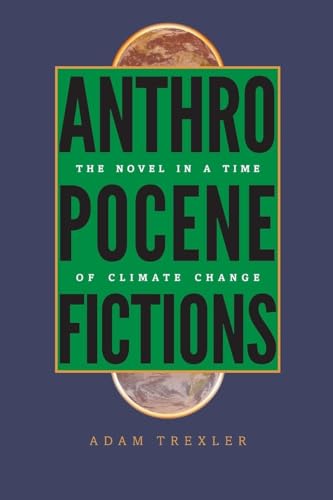
Adam Trexler, ‘Anthropocene Fictions: The Novel in a Time of Climate Change’ (Charlottesville, VA: University of Virginia Press. 272pp.)
In other reviews in this series (for example Barbara Kingsolver’s novel ‘Flight Behaviour’ in 2012), I have pointed out the rapid growth around the year 2010 in the number of novels taking climate change as their inspiration or motif. Climate fiction, or Cli-Fi, was part of the cultural turn in climate change studies which occurred around this time, when the cultural origins and ramifications of humanity’s entanglement with its climate future became ever clearer.
Around this time, a young American literary scholar Adam Trexler became interested in the relationship between climate change and literature and in 2008 took-up a post-doc position at the University of Exeter in the UK, funded by the EU’s Social Fund. The result of his four years at Exeter was the book ‘Anthropocene Fictions: The Novel in a Time of Climate Change’, published in 2015. Trexler explained that he was initially sceptical that there would be a sufficient number of novels about anthropogenic global warming to warrant his research project. By the early 2010s his view had changed: “My original assumption that there simply wasn’t enough climate change fiction was slowly eroded … more climate change novels kept presenting themselves.” [p.7]
‘Anthropocene Fictions’ engaged seriously with hundreds of these novels, one of the first monographs to apply a critical literary perspective to how novelists were grappling with the idea of climate change in their fiction. In Trexler’s view, while anthropogenic climate change had profoundly impacted the Earth, the idea of climate change had not sufficiently impacted the literary response to such a level of environmental change. He argued that ecocriticism’s theories of place and planet should be unsettled by a climate that was now neither natural nor under human control. Sam Solnick’s review of ‘Anthropocene Fictions’ rated it as “perhaps the most comprehensive study of climate change in fiction to date. Due to its range and its willingness to ask how the idea of climate change might transform how fiction is written and read, it may well be an important reference point for some time to come.”[6] More than a decade later, the book certainly continues to be widely cited, still gathering over 100 citations per year.
After writing ‘Anthropocene Fictions’, Trexler’s career has moved in a very different direction. He became an innovator in physical cryptocurrency and established Valaurum Inc., a leader in currency minting technology. However, a few years ago he wrote a postscript to his book which appeared in an edited 2023 collection of essays. Trexler there reflected on how he had characterised (erroneously he now thought) the majority of early cli-fi novels as viewing “global warming as a remote threat with a binary choice: humanity as a whole would either avert the crisis completely or suffer a dystopian or apocalyptic fate.”[7] Trexler then observed that more recent Cli-Fi, written since ‘Anthropocene Fictions’ had been published, had engaged more directly with class and racial tropes and had become distinctly more polyphonic. The stark binary choice between either solving climate change or being destroyed by it had blurred.
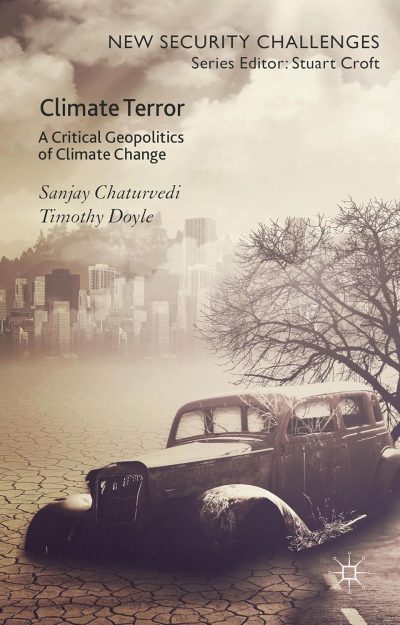
Sanjay Chaturvedi and Timothy Doyle, ‘Climate Terror: A Critical Geopolitics of Climate Change’ (Basingstoke: Palgrave Macmillan. 247pp.)
Two of my colleagues at the University of East Anglia published a research article in 2009 in the journal Science Communication, titled ‘Fear Won’t Do It’. Interpreting empirical evidence using social psychological theory, Saffron and Sophie stated that although shocking, catastrophic and fearful public representations of the impacts of climate change “may well act as an initial hook for people’s attention and concern, they clearly do not motivate a sense of personal engagement with the issue and indeed may act to trigger barriers to engagement such as denial.”[8]
In 2015, two political scientists—Sanjay Chaturvedi (b.1957) from Panjab University in India and Timothy Doyle (1960-2025) at the University of Adelaide, Australia—examined this same fearful framing of climate change through a critical geopolitical lens. In their book ‘Climate Terror: A Critical Geopolitics of Climate’, these two authors, citing the famous ‘doomsday clock’ of the Bulletin of the Atomic Scientists, interrogated the effect that putting climate change alongside the same alarmist existential categories as nuclear war and biosecurity had on national and international politics. [p.1] Saffron and Sophie had shown in 2009 that fear-messaging about climate change generated perverse outcomes at the level of the individual. Chaturvedi and Doyle now argued that the language of “climate terror” perpetuated a world riven by inequality, reactivated colonialism, the suppression of democratic agonism, and new forms of green neo-liberalism. It supported the securitisation and militarisation in the governing of climate risk, all in the name of an existential crisis. ‘Climate Terror’ sought to offer “a relentless interrogation of the complex geography behind the politics of [climate] fear and the ways in which various parts of the globe, especially in the Global South, are implicated in, and at the same time induced by, doomy Malthusian scenarios of climate catastrophism.” [p.xiii]
Chaturvedi and Doyle’s book was published three years before the global rush to declare a ‘climate emergency’, by institutions ranging from junior schools to the United Nations and all scales in between. They would surely have recognised a perpetuation of the iron grip of terror politics that such a move promoted. Their own words pointed in this direction when they wrote that what is “common to both the war on terror and the securitization/militarization of climate change is the speculative pre-emption of future threats and dangers.” For Chaturvedi and Doyle, the risk amplification implied in the declaration of ‘climate emergency’ is used “to justify the manipulation of socio-spatial consciousness and policy intervention by [political] powers … in the name of a moral economy that is heavily skewed in favor of the securing of future citizens.” [p.13]
[1] Soukup, P.A. (2023) Laudato si’ as a Communication Phenomenon. La Civilta Cattolica. 17 November.
[2] Gillis, J. (2015) Pope Francis aligns himself with mainstream science on climate. New York Times. 8 June.
[3] Nche, G.C., Nortjé-Meyer, L. et al. (2022) Is the Pope’s hope being dashed? Five years of research on Laudato Si. Worldviews: Global Religions, Culture, and Ecology. 27(1-2): 115-180
[4] These were: Caritas Europa, Coopération Internationale pour le Développement et la Solidarité (CIDSE), the Commission of the Bishops’ Conferences of the EU (COMECE), Don Bosco International, the Jesuit European Social Centre, Justice and Peace Europe, and the Laudato Si’ Movement.
[5] O’Riordan, T., McGowan, A., et al. (2015) The legacy of the Papal Encyclical. Environment: Science and Policy for Sustainable Development. 57(6): 2-5.
[6] Solnick, S. (2017) Anthropocene fictions: the novel in a time of climate change, by Adam Trexler. Green Letters. 21(1): 93-95.
[7] p.235 in: Rosenthal, D.J. and Molesky, J. de L. (eds.) (2023) Cli-Fi and Class: Socioeconomic Justice in Contemporary American Climate Fiction. Charlottesville: University of Virginia Press.
[8] O’Neill, S.J. and Nicholson-Cole, S. (2009) ‘Fear won’t do it’: Promoting positive engagement with climate change through imagery and icons. Science Communication. 30(3): 355-79.