
HRH The Prince of Wales, Tony Juniper and Emily Shuckburgh, ‘Climate Change: A Ladybird Expert Book’ (London: Penguin Random House. 51pp.)
1 November 2026, roughly an 8-minute read
This essay continues my series of monthly posts in which I select one ‘climate’ book to highlight and review from one of the 44 years of my professional career in climate research (starting with 1984, my first year of academic employment). The series will end in September 2027, the month in which I shall retire. See here for more information about the rational for this series, and the criteria I have used in selecting my highlighted books.
This ‘2017 essay’ can be download as a pdf.

Let me confess that I am a ‘Ladybird book kid.’ I belong to the generation of children who grew up during the 1950s, ‘60s and ‘70s with the iconic Ladybird educational books as my companions. Between the early 1940s and 1980s, the firm Wills & Hepworth (later sold to Pearson in the 1970s before being bought by Penguin in the 1990s) published 646 of these pocket-sized mini-hardback children’s books. They covered a vast array of subjects—from the birds of Britain to cricket, Kings and Queens of England, the weather, and much more—and were translated into more than 60 languages. The compact format and attractive visuals—a 50/50 split between text and hand-drawn illustration, text on the left-hand page with a single illustration on the facing page—were distinctive and made it easy for children to handle the books and engage with them.
I spent many hours reading and re-reading my collection of Ladybirds, which must have amounted eventually to more than 100, many of them handed down from my older brother and sister. I even think the seeds of my later professional career were first sown by the Ladybird book ‘The Weather’, first published in 1962 and whose illustrations I can remember to this day. Dan Anthony, reflecting in 2015 on the Ladybird phenomenon, captured the essence of these books: “Ladybird’s positive, family orientated, inquisitive titles touched on a vast array of subjects. From early years reading books, to fairy stories, to explanations of satellite technology, cars and jet engines, Ladybird transmuted the world of mutually assured nuclear destruction into a warm, friendly and supremely British version of reality.”
The classic Ladybird books that I remember were a post-1940 phenomenon, but the very first Ladybird title was published by Wills & Hepworth in the middle of the First World War, which is when the imprint was first registered. On the hundredth anniversary of this registration, in October 2015, Penguin Books announced they were reviving the imprint with a series of spoof books called ‘Ladybirds for Grown Ups.’ The eight books in the series parodied the style and artwork of the company’s originals for children, pairing the style of the classic illustrations with new text written by two television comedy writers. These spoofs were published in November 2015 and included ‘The Hangover’, ‘Mindfulness’, ‘Dating’ and ‘The Hipster.’
The commercial success of these parodies—three million copies were sold—prompted Penguin to further exploit the brand and they commissioned a new series to be called Ladybird Expert books. These ‘serious adult books’ would adopt the classic Ladybird format—so familiar to millions of Britain’s baby-boom generation—providing short, clear, accessible and authoritative introductions on subjects drawn from across science, history and culture. The first title in this new expert series, published in January 2017, was ‘Climate Change’, and I have selected HRH The Prince of Wales’, Tony Juniper’s and Emily Shuckburgh’s ‘Climate Change: A Ladybird Expert Book’ as my 2017 Climate Book of the Year.
The idea for the book originated with the then Prince Charles, shortly after he returned from attending COP21, the meeting at which the Paris Agreement on Climate Change had been signed. His long-standing friend and politician Nicholas Soames suggested to him in a casual conversation about the outcome of Paris, “Why don’t you provide a plain-English guide to the subject?” The idea immediately appealed to the Prince and he phoned the environmentalist Tony Juniper—then President of the Royal Society of Wildlife Trusts and whom he had known for a long time—and, through him, enrolled Emily Shuckburgh, a polar scientist at the University of Cambridge.
The idea of appropriating the Ladybird brand to promote the book was, apparently, that of Juniper’s wife, Sue Sparkes. “I spoke to my wife the day the Prince phoned,” Juniper said, “and she said, ‘Well, it sounds like a Ladybird book.’ So, I wrote Prince Charles asking if he’d like to explore that possibility and he said, ‘Yes, let’s try it.’”[1] The timing was fortuitous. As mentioned above, after the 2015 success of the ‘Grown-Ups’ series, Penguin editors were already contemplating a new, more sober series of expert Ladybirds: “…the [phone] call and the idea from Clarence House [the Prince’s office] was the catalyst for the new series,” said a publishing editor.
The Ladybird ‘Climate Change’ book was short, as were all Ladybirds. It was about 5,000 words in length and contained 24 individual topics, each with about 250 words of text. Each spread comprised a page of non-technical text facing a full-page hand-drawn illustration of the topic. The latter were specially commissioned from illustrator Ruth Palmer, but drawn in the vintage Ladybird style. “Facts were important, but it was the artwork that was captivating children. More and more, [Douglas] Keen [who provided Ladybird’s early inspiration] relied on illustrators that could make information exciting.”[2] Juniper and Shuckburgh originally proposed the 24 topics and these were refined through intense and repeated conversations with Charles. They were also peer reviewed by seven independent experts overseen by the Royal Meteorological Society. The Prince was very hands-on in thinking through the content of the book, Shuckburgh told me, and, like Keen, obsessed about the illustration designs. For example, he wanted an illustration for the front cover that reflected something tangible and relatable for prospective readers, rather than an image drawn from abstract global science. A picture of high street flooding in Uckfield, East Sussex, did the job perfectly.[3]
The selected topics covered aspects of the climate change science, impacts and solutions. Shuckburgh would later explain they wanted the book to provide capsule summaries of some of the highlights of the Working Group 1, 2 and 3 reports from the IPCC’s Fifth Assessment Report, published a few years earlier in 2013/14. So, there were topics on “melting ice and rising sea levels”, “causes of recent climate disruption”, and a series of spreads on “solutions”—forests, energy, food and farming, the circular economy. There was also an item on the Paris Agreement which had originally seeded the idea for the book. The final version of the text and illustrations was agreed between Charles, Juniper and Shuckburgh in August 2016 at a meeting at Balmoral Castle in Scotland, where the prince was holidaying.
Published in January 2017, ‘Climate Change’ launched the new Ladybird Expert series and was shortly followed in the first tranche of titles by ‘Quantum Mechanics’, ‘Evolution’, ‘the Battle of Britain’ and ‘Shackleton.’ (By the time the series closed in 2019, a further 29 Ladybird Expert titles had appeared). The combination of royal co-authorship and Penguin’s publicity machine ensured ‘Climate Change’s high visibility. Most of the UK’s national daily newspapers ran reviews of the book, or stories about its making, including the more climate sceptical press such as The Daily Mail and The Sun. The latter newspaper, for example, discussed the book in the context of recent flooding events in the UK. ‘Climate Change’ went almost immediately to the top of the Sunday Times bestseller list.
Writing in March that year, the communications scholar Adam Corner praised the book as a “climate communication masterpiece”. With strong sales and positive coverage in the right-wing press, Corner concluded that “the Prince’s children’s [sic] book has found a way to speak across the divided politics of climate change.” Corner went on to say that ‘Climate Change’ had
…a sense of urgency, but in no way does it feel overcooked (as some environmentalist writing can). It is written in a direct, functional—perhaps even unadventurous—style. But the absence of polemicism and grandstanding is likely to have been a good thing for the audience the book was aimed at.
Ironically, while praising the book for targeting its audience well, Corner had misunderstood the target audience. ‘Climate Change’ was aimed not at children but lay adults. Juniper would later describe the purpose of the book as “trying to bring the facts to the fingertips of the people who’ve got most to gain by finding solutions in time”.
This first title in Ladybird’s new expert series gained attention because of its unique combination of two prominent symbols of British culture: the monarchy and the trusted Ladybird imprint. Copies of the book formed part of Britain’s soft diplomacy.[4] Every UK embassy in the world received copies of the book and it also was used as part of the UK Government’s campaign during 2022 to secure the election of British energy policy expert, Jim Skea, as the fifth chair of the IPCC. Copies were liberally distributed to governmental representatives at IPCC meetings to demonstrate British commitment and innovation with regard to climate change communication. (Skea was duly elected as IPCC Chair in July 2023).
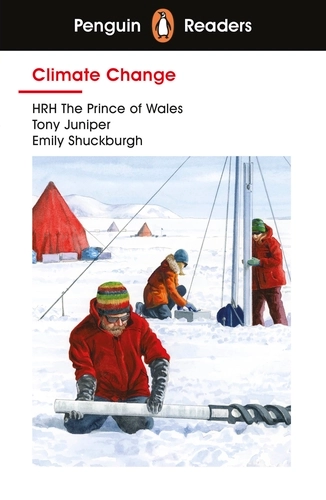
The Prince’s royal connections also facilitated the appearance of a French translation of the Ladybird book. Even more notably, a version of the book was published in Penguin’s “Young Readers” series (see cover image shown). Penguin Readers provided a comprehensive graded reader series for those learning English as a foreign or second language (EFL/ESL students). The ‘Climate Change’ Penguin Reader was a Level-3 reader, designed for young readers to help build confidence in their English language comprehension.
Penguin discontinued their adult ‘Expert Series’ in 2019, but the success of the Ladybird version of ‘Climate Change’ persuaded the publisher that a special children’s edition of the book would help with their planned revival of the original Ladybird market which was 7- to 11-year-olds. These books were to be newly marketed as “collectable books for curious kids.” So, in March 2023, a second (children’s) edition of ‘Climate Change’ was published. The material from the original 2017 Ladybird was updated and rewritten to make it accessible to children and the number of spreads was reduced from 24 to 19, of which six were devoted to ‘solutions.’ The artwork, still hand-drawn and again specially commissioned, was more ethnically “diverse” and Charles—now King, but referred to in the book as “formerly the Prince of Wales”[5]—wrote a more personal and emotive preface. The book was launched by (the now) King Charles III in February 2023 at a reception held at Buckingham Palace, attended by politicians, businesspeople and Indigenous leaders from around the world.
Unlike many of the books I’ve reviewed in this series, the 2017 Ladybird Expert book on ‘Climate Change’ did not break any new ground in the analysis or interpretation of climate change. But it served as a good example of communicating climate change in new and distinctive ways. Combining royal patronage with the unique Ladybird brand, it showed some of the different functions that the idea of climate change could fulfill—royal advocacy of a cause (royalties from sales went to the Prince of Wales’s Charitable Foundation), servicing Britain’s soft climate diplomacy, engaging with children’s learning, and helping those studying English as a foreign or second language.
© Mike Hulme, November 2026
Subscribe to our newsletter!
Other significant books published in 2017
Alex Evans, ‘The Myth Gap: What Happens When Evidence and Arguments Aren’t Enough?’ (London: Eden Books. 176pp.)
For those who have been following earlier reviews in my ‘Climate Books of Year’ series, you will know that the scientific, economic and technological framing of climate change that had prevailed in the late twentieth century had, by the late 2000s, been found wanting. Social scientists, humanists, philosophers, novelists, religious sages, and Indigenous activists had, in increasing numbers, turned their attention to the profound predicament of humanity’s entanglement with its future climate. The limits of purely techno-rational solutions to climate change were clear to many. By the early 2010s, the framings of what had originally been termed “the CO2 problem” had diversified. So too had the range of responses (I would hesitate to call them ‘solutions’). Pope Francis’ 2015 encyclical, Laudato Si’ (reviewed here), was in some ways a culmination of this cultural turn in climate change studies. And in 2017, Alex Evans’ short punchy book, ‘The Myth Gap: What Happens When Evidence and Arguments Aren’t Enough?’, was another.
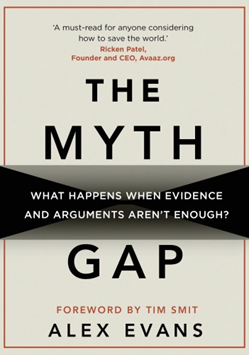
The significance of ‘The Myth Gap’ was twofold. First, in less than 25,000 words, Evans offered a plainly written, but engaging account of the limitations of the techno-rational approach to arresting climate change. For those who had followed the cultural turn in climate change studies over the previous ten years there was, perhaps, nothing surprising here. But what Evans offered was a fresh, persuasive and compelling defence of the logic of the culture-first, rather than the science-first, approach to understanding climate change. In a short Foreword to the book, Tim Smit co-founder of the Eden Project, wrote that it was through poets, wordsmiths and storytellers that redemption lay or, in Evans’ words, “we all need to discover and develop our capacity to tell stories: not just on our own, but together.” [p.xxi] This reminded me of the position advanced by the Alliance of Religions and Conservation in their 2007 manifesto, “The emphasis on [science], consumption, economics and policy usually fails to engage people at any deep level because it does not address the narrative, the mythological, the metaphorical… The faiths are the holders of these areas and without them, policies will have very few real roots.”
w‘The Myth Gap’ was also significant because of its author, Alex Evans. In his Introduction, Evans recounted his role as a climate policy advisor during the decade from 2002 to 2011, first to the Blair Government, then to the UN Secretary-General in New York. During that roller-coaster decade, Evans saw the world of international climate politics up close, remembering feeling “giddy with excitement” at the prospects for the UN High Level Panel on Global Sustainability meeting in 2011. Yet that meeting was to catalyse his eventual disillusionment, “the last vestiges of my naivety fell away” [p.xviii]. It was only several years later that Evans felt able to write this book, by which time he had moved decisively away from the world of high-level climate summitry in which he had previously worked.
Daniel Bodansky, Jutta Brunnée and Lavanya Rajamani, ‘International Climate Change Law’ (Oxford: Oxford University Press. 416pp.)
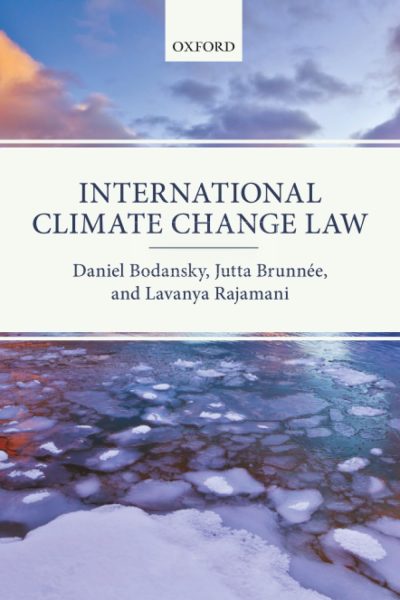
The development of international climate change law can be said to have begun in 1992 with the signing of the UN Framework Convention on Climate Change. Twenty-five years later, in 2017, three prominent legal scholars combined forces to write this comprehensive and accessible overview of the legal instruments and sources that governed the international response to climate change. The American, Bodansky, the Canadian, Brunnée, and the Indian, Rajamani, published ‘International Climate Change Law’, conceived and designed as an introductory guide to the legal regime governing climate change. The three authors justified the importance of such a guide: “The UN climate regime … has remained remarkably resilient and its basic principles and procedural elements have remained salient throughout its meandering history.” [p.v] More than a decade later, we begin to see some of the elements of this regime fraying or weakening, but this book remains a relevant text since it signalled a high point in the international governance of climate change.
‘International Climate Change Law’ started with a primer on international law and treaty-based law-making in general, followed by a description of the origins and evolution of the UN’s climate regime. The heart of the book was the authoritative guide to the three primary legal texts that shaped the architecture international climate governance—the 1992 UN Framework Convention, the 1997 Kyoto Protocol, and the 2015 Paris Agreement. But the authors also discussed other elements of international climate change law. These included climate-relevant legal instruments operating outside the UN regime—such as the International Civil Aviation Organization and regional and national climate change laws—as well as an assessment of how international climate change law intersects and interacts with other areas of international regulation, such as the World Trade Organisation.
Bodansky, Brunnée and Rajamani’s book may not make for exciting reading for a general audience. But these three legal scholars offered a superb overview of the legal aspects of climate change, for example demonstrating how the terms employed in the relevant instruments and conventions should be interpreted. They also provided two valuable inventories: one, a listing of international courts and tribunals—which have of course multiplied in the decade since the book appeared; the other, a table of international legal instruments and of national legislation, with reference to where each of them were discussed in their text.
[1] Williams, S. (2017) ‘Exclusive preview of a new Ladybird book’. The Daily Telegraph. 21 January.
[2] ‘The Ladybird Books Story’ (2026) Timeshift | British History Documentary. 3 January.
[3] Emily Shuckburgh, pers. comm., 4 March 2026.
[4] Emily Shuckburgh, pers. comm., 4 March 2026.
[5] The reason for this was that the proofs of this children’s book went to the printers on the very day the Queen died, 8 September, 2022 and yet Charles was not officially crowned King until the following May.
