

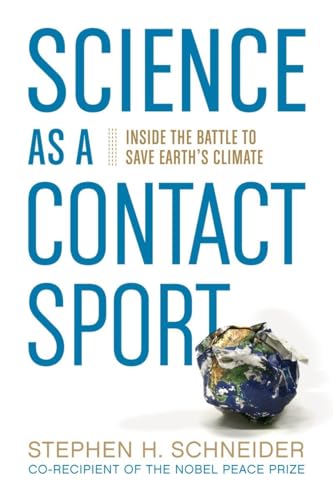
Schneider,S.H. (2009) Science as a Contact Sport: Inside the Battle to Save Earth’s Climate. Washington, DC: National Geographic Society. 295pp.
This essay continues my series of monthly posts in which I select one ‘climate’ book to highlight and review from one of the 44 years of my professional career in climate research (starting with 1984, my first year of academic employment). The series will end in September 2027, the month in which I shall retire. See here for more information about the rational for this series, and the criteria I have used in selecting my highlighted books.
This ‘2009 essay’ can be download as a pdf.
2009 was a pivotal year in the story of climate change. It was the year during which it was hoped that the institutional architecture for tackling climate change that had been put in place since the late 1980s—the IPCC (in 1988), the UNFCCC (1992), the annual UN Conferences of the Parties (COPs, starting in 1995), the Kyoto Protocol (1997)—would culminate in a stronger and more encompassing global climate treaty to be signed at COP15 in Copenhagen in early December.
In terms both of public awareness and advocacy and climate policy, it was believed that the years preceding COP15 had seen incremental steps towards realising this ambition. Hollywood had ‘got’ climate change with its blockbuster disaster movie ‘The Day After Tomorrow’ (in 2004), the discipline of economics had been mobilised through the world’s first large-scale carbon emissions trading system, the EU’s ETS (2005), and the Stern Review on the economics of climate (2006)[1], Al Gore’s ‘climate missionary movement’ was making waves at least in the western world (2006)[2], and new social movements such as Bill McKibbin’s 350.org (2007) were ratcheting up both fear and hope. The fear was communicated by promulgating the idea of an impending climate catastrophe; the hope by advocating for an international agreement at Copenhagen that would begin to bend the curve of global carbon emissions.
In the weeks before COP15 media headlines were announcing it was the last chance saloon. “Copenhagen: Last chance to save the planet, Lord Stern”, blared The Daily Telegraph), while Time Magazine reported that for “advocates of action on global warming, the Copenhagen summit represents the last, best chance to slow and eventually reverse the growth in greenhouse-gas emissions before climate change begins to spin out of control.” But these hopes were to be dashed. Writing a few years later, Matt McGrath, the BBC’s environment correspondent, summarised the outcome: “Copenhagen, or Hopenhagen as it was cloyingly dubbed, was a meeting that was meant to ‘save the planet’. It ended in farce and failure.”
Amidst this over-hyped run-up to the Copenhagen COP in the autumn of 2009 appeared a book from one of the world’s most prominent and outspoken climate scientists. It was published just two weeks before the controversy that became known as Climategate—the release of apparently incriminating emails exchanged between leading climate scientists—first broke. Given the confusion, arguments and vitriolic rhetoric about climate science and scientists that ensued in the weeks that followed, this new book was fittingly titled, ‘Science as a Contact Sport: Inside the Battle to Save Earth’s Climate.’ I have therefore selected Steve Schneider’s autobiographical account of his career in climate science as my 2009 Climate Book of the Year.
Stephen Henry Schneider (1945-2010) was a giant among climate scientists and a notable public communicator of science. From the early 1970s to 2010, Schneider was the climate scientist perhaps most synonymous with the unfolding story of climate change. His career in climate science had started nearly 40 years earlier in 1971, when he joined NASA’s Goddard Institute for Space Science (GISS) in New York as a young post-doc. ‘Science as a Contact Sport’ offered a compelling autobiographical account of his subsequent career in science, public communication and policy advice and advocacy.
There were few things related to climate change that Schneider did not get involved in: high profile scientific papers, launching a new journal, writing books (I reviewed an earlier one from 1984 in this series), media communicator and public debater, expert testifier before the US Congress, shaper of IPCC assessment reports, and much more. ‘Science as a Contact Sport’ charted many of these involvements, starting with the public controversy about an impending ice age he found himself involved in as a junior scientist in 1971. The controversy stemmed from a very early computer modelling study, co-published with senior scientist at GISS, Ichtiaque Rasool. The study found that by 2100 the cooling effect of plausible future levels of industrial aerosols would outweigh the warming effects of plausible future concentrations of carbon dioxide by a factor of four.[3] In Chapter 1, Schneider told this story with candour and explained its ramifications—it led to him receiving a job offer from NCAR at Boulder, Colorado, an offer he took up in the autumn of 1971.
The following eight chapters covered some of the more salient engagements of his career—the arguments in the early 1980s about ‘nuclear winter’, controversies from 1995 about whether or not the IPCC had appropriately reported the detection of human influence on the climate system, negotiating the Kyoto Protocol in 1997, and the persistent challenge of how to use the media to communicate to public audiences both the uncertainties of climate science and the significant risks of unmitigated climate change.
With regards to this latter challenge, Schneider offered his own version of a widely circulated quote of his which first appeared in an interview conducted by Jonanthan Schell for Discover magazine in 1989. Schneider’s explanation of his approach to climate science communication included what he called “the double ethical bind”, namely, “Each of us has to decide what the right balance is between being effective and being honest.” As Schneider wrote in ‘Science as a Contact Sport’, this extract was widely used by contrarian commentators to cast doubt on climate scientists’ integrity. But the full quote from that 1989 interview ended with a line that was frequently left out, “I hope that means being both [i.e., effective and honest]”. I fell into this trap myself, quoting it without the final qualifying sentence in my book ‘Why We Disagree About Climate Change’ and had to later issue a correction.[4]
Schneider’s “double-ethical bind” brought into focus the thorny question about whether—and if so how, where and when—climate scientists should engage in policy advocacy. He had strong views on this question which was evidenced by his public response to Roger Pielke jr., who reviewed his book in the pages of Nature. Submitting an item of correspondence to the journal a few weeks after Pielke’s review had appeared, Schneider defended himself against the charge that ‘Science as a Contact Sport’ implied that “science compels [policy] action on climate change” and that “scientists assert their authority” to “compel political agreements”. To these charges issued by Pielke, Schneider wrote that although “policy advocacy by scientists is inappropriate in formal assessments, such as those of the IPCC … as citizens, scientists may have personal-value positions on policy.” When involved in public advocacy, Schneider went on to say, “they must clearly lay out their world views and separate the more objective scientific issue of risk assessment from the value laden risk-management part. Contrary to Pielke’s implication, I am aware of this ‘paradox’.”[5]
In all of this, Schneider framed the relationship between climate science and its public reception as one of conflict. The book’s title and sub-title make this clear, as too does the book’s dust jacket. This promotes the book as “a firsthand account of a scientific and political odyssey” which “reveals the struggles that have taken place behind the scenes and the people who try to repair the damage, as well as those who will stop at nothing to deny that climate change is happening”. Later, in the text itself, Schneider adopted this embattled pose: “I’ve been here, on the ground, in the trenches, for my entire career. I’m still at it, and the battle, while looking more winnable these days, is still not a done deal” [p.5], and then later, when reflecting on advice he received from the veteran American anthropologist Margaet Mead in the 1970s, “I’m still hanging in, slogging in the trenches of the climate wars” p.69]. It was fitting for the New York Times to refer to him as a “climate warrior.”
These quotes reveal something about Schneider’s personality and character. When dealing with the big media blow-up in 1971, he came across as a confident, somewhat brash, 27-year old. His public speech and media appearances in the 1970s irritated an older generation of climatologists who believed that scientists should communicate tentative scientific findings more cautiously in public settings. Summarising a well-publicised spat between Schneider and Helmut Landsberg, head of the Environmental Data Service at the United States Weather Bureau, Gabe Henderson remarked, “Appearing on television shows, in magazine articles, publishing popular works – these activities suggested that Schneider was sacrificing the credibility of the scientific profession for the purpose of raising his own political profile.”[6] It was certainly true that Schneider was never reticent of putting his views across, whether in scientific meetings, speaking to the media, or in small group settings. To adopt his military metaphorical trope, he was always up for the fight. I met Schneider a few times during the 1990s and early 2000s and remember one occasion when, in a meeting being held in the Tyndall Centre, he forcefully corrected me about the obstacles to vehicle electrification.
Nevertheless, as his 1989 interview with Discover magazine reveals, Schneider saw himself as being both “honest and effective” in his public words and writings about climate change. He had rapidly grasped the new opportunities for public communication offered by the internet in the 1990s and maintained a website containing many of his public-facing communications about climate change science, policy and actions. This website is still live today and includes examples of open engagement with his critics and detractors, including his response to critics of ‘Science as a Contact Sport’. The website also includes video recordings of some of his speeches and interviews, including one from the book launch of ‘Science as a Contact Sport’ which took place on 3 November 2009 at the Commonwealth Club at Stanford University.
Eight months after this book launch, Steve Schneider was dead. Flying into London Heathrow airport from Sweden on 19 July 2010, he suffered a heart attack and his sudden death, aged 65, reverberated around the climate world. At the time I was attending a workshop at Cumberland Lodge in Egham, Surrey, discussing climate change communications, risk perception and public engagement. As the news came through to us the following day, the workshop dinner spontaneously offered a heart-felt toast to Schneider, recognising the huge contributions he had made to the topics we were discussing.
Writing ‘Science as a Contact Sport’ so shortly before his death leaves us with a valuable insight into Schneider’s career, as he remembered it, and the book is significant for this reason. His legacy also lives on through his maintained website and through the proceedings of a three-day symposium held in his honour a year later, in 2011. This was held at NCAR, his professional home for 25 years before he became professor of environmental biology and global change at Stanford University. The symposium paid tribute to Schneider’s many contributions to climate science and evaluated their historical significance. It also identified key challenges for climate science, for climate science and policy, and for climate science communication, and how to address them. Schneider had inspired generations of students during his career, many of whom were represented among the speakers at his memorial symposium.
© Mike Hulme, March 2026
Subscribe to our newsletter!
Other significant books published in 2009
Giddens,A. (2009) The Politics of Climate Change. London: Polity Press. 264pp.
Professor Anthony Giddens, Baron Giddens of Southgate, is one of the most prominent of modern sociologists. Born in 1938, Giddens served as Director of the London School of Economics from 1997 to 2003, where he is now Emeritus Professor at the Department of Sociology. He is best known for the theory of structuration which he developed during the 1970s and 1980s and for his critique of postmodernity. His identification of a possible ‘third way’ in politics had considerable influence over Tony Blair’s New Labour in the 1990s. But ‘The Politics of Climate Change’, published in 2009, was Giddens first sustained engagement with the topic of climate. His earlier work, ‘Beyond Left and Right: The Future of Radical Politics’ (Polity, 1994), had only briefly touched on the subject, framing climate change as a “manufactured risk” underwritten by “ambiguous evidence.” And ten years later, in ‘The Progressive Manifesto: New Ideas for the Centre-Left (Polity, 2003), climate change was notable only by its complete absence. But now, aged 71, Giddens turned his mind to this issue, his book joining the large gathering of voices with something to say in the months leading up to the COP15 negotiations at Copenhagen.
Giddens was sceptical of the way in which the politics of climate change was being framed at the time. “Politics-as-usual won’t allow us to deal with the problems we face”, he wrote, “while the recipes of the main challenger to orthodox politics, the green movement, are flawed at source.” In contrast to some of his earlier work, in ‘The Politics of Climate Change’ Giddens put much emphasis on national rather than international decision-making. Ahead of the abortive attempt at Copenhagen to forge a “grand, Kyoto-style bargain” between nations, Giddens accurately observed that such comprehensive treaties would always disappoint: the divergent interests and perceptions between nations and other key political actors were just too great.[7]
I reviewed the book for the journal International Affairs, observing that “having offered us the enabling state in the 1990s, Giddens now deploys the idea of the ensuring state for tackling climate change for the 2010s.” Attending to climate change demanded, for Giddens, a retooling of the state to exercise regulation, monitoring and enforcement. This represented a more intrusive role for government than he might have claimed 20 years previously. Giddens was critical of the faith placed in carbon markets and of the political analysis of the carbon economy found in much of the Stern Review.[8] ‘The Politics of Climate Change’ was re-issued in 2011 in a fully revised edition.
Hulme,M. (2009) Why We Disagree About Climate Change: Understanding Controversy, Innovation and Opportunity. Cambridge: Cambridge University Press. 393pp.
It is maybe self-serving to identify my own work as one of the “significant” books of 2009, but I don’t feel I need to make too many apologies. ‘Why We Disagree About Climate Change: Understanding Controversy, Innovation and Opportunity’ has become one of the most widely cited and debated books on climate change in the academic literature, gathering nearly 5,000 Google Scholar citations since 2009 (25 per cent more than Giddens’ ‘The Politics of Climate Change’) and, 16 years after publication, still acquiring around 20 new citations each month.
‘Why We Disagree About Climate Change’ (WWDACC) was published in April 2009, seven months before the Climategate email controversy broke, eight months before the fiasco of the climate negotiations at COP15 in Copenhagen, and nine months before serious criticisms surfaced about “errors” in the IPCC’s Fourth Assessment Report published two years previously in 2007. I wrote the book during the winter of 2007/8 while on sabbatical leave following my retirement from the directorship of the Tyndall Centre for Climate Change Research, but as I explain in the book’s Preface, the idea and structure of WWDACC was established in my mind as early as February 2003. What had disturbed me then, and thus what motivated the book, was that although science had shown conclusively that humans were significantly changing the climate, science was powerless to resolve the differences of beliefs, values and political preferences which condition the types of responses or solutions being proposed to deal with it. These deeper rationales, or master-narratives, needed elucidating and openly debating rather than using the mantra ‘the science demands this or that’ to suppress these differences.
WWDACC was admired by many different readers—from the worlds of research, education, policy, and civil society—and was adopted as a core text in many undergraduate and graduate seminars around the world in a wide range of disciplines: geography, environmental studies, environmental engineering, political science, development studies, anthropology, sociology. The book was extensively reviewed, in both popular and academic media, and spawned its own Wiki page. A few years later, for a book containing my collected writings on climate change, I wrote a short chapter about the wide range of reactions to WWDACC. I concluded this 2013 essay with a retrospective summary of how WWDACC frames the idea of climate change: “Climate change thus becomes a synecdoche … for something much more important than simply the ways humans are changing the weather. Climate change is a synecdoche for our confusion and anxiety about the goals, ambitions and destinies we foresee for ourselves and our progeny, even before we worry about whether … we can realise them.”[9]
[1] Stern,N. (2006) The Economics of Climate Change: The Stern Review. Cambridge University Press. 692pp.
[2] Haag,A. (2007) Al’s Army. Nature. 446 (12 April): 723–24.
[3] Rasool,S.I. and Schneider,S.H. (1971) Atmospheric Carbon Dioxide and Aerosols: Effects of Large Increases on Global Climate. Science: 173: 138-141.
[4] p. 347 in: Hulme,M. (2009) Why We Disagree About Climate Change: Understanding Controversy, Innovation and Opportunity. Cambridge: Cambridge University Press.
[5] Pielke Jr.,R. (2010) Tales from the climate-change crossroads. Nature. 464: 352-353. 18 March. Schneider,S.H. (2010) Climate policy: role of scientists in public advocacy. Nature. 464: 1125. 22 April.
[6] p.75 in: Henderson,G. (2014) The dilemma of reticence: Helmut Landsberg, Stephen Schneider, and public communication of climate risk, 1971-1976. History of Meteorology. 6: 53-78.
[7] Gamble,A. (2009) Book of the Week: ‘The Politics of Climate Change’. Times Higher Education. 9 April.
[8] Hulme,M. (2009) in International Affairs. 85(5): 1022-23.
[9] p.298 in: Hulme,M. (2013) Reactions to ‘Why We Disagree About Climate Change.’ pp.287-298 in: Exploring Climate Change Through Science and in Society: An Anthology of Mike Hulme’s Essays, Interviews and Speeches. Abingdon: Routledge.