
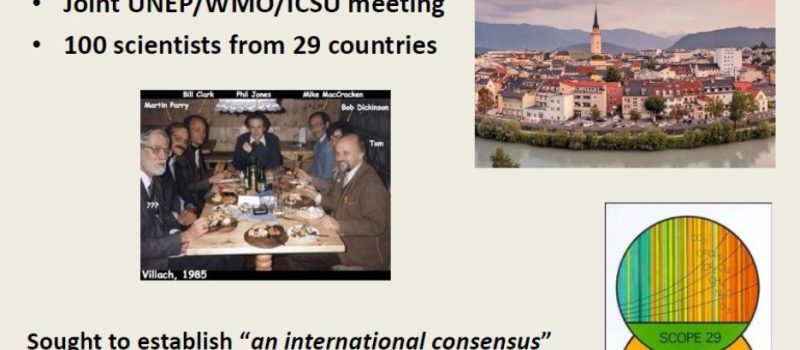
You can find here a recording of this talk, ‘Framing “the Climate Issue” 40 Years After the 1985 Villach Conference: What Has Been Achieved and What is Still to Achieve?’, delivered on Monday 17 November 2025 in the Bradford Seminar Series of the Centre for Policy Research on Energy and Environment at Princeton University. My host was Professor Navroz Dubash, Professor of Public and International Affairs and the High Meadow Environmental Institute, Princeton, and whom I have known for 15 years.
Abstract of the talk: Forty years ago last month, about 70 climate scientists and environmental policy analysts convened in the Austria town of Villach for a conference organized under the auspices of UNEP, the WMO and ICSU titled, ‘An Assessment of the Role of Carbon Dioxide and of Other Greenhouse Gases in Climate Variations and Associated Impacts’. This meeting is widely regarded as laying the foundations for establishing an ‘international climate change regime’ for controlling human influences on the climate system. Managing the risks of a changing global climate has been framed in many ways over the intervening 40 years. During this period, the world has warmed by nearly 1°C but—perhaps more importantly—it has also changed geopolitically in unpredicted ways. In this talk, I will briefly survey the changing policy framing of climate change since Villach in 1985, and what these frames have and have not achieved. As the international climate regime originally designed in the 1990s continues to strain, and begins to fragment, new ways of thinking about the ‘climate issue’ are needed. Rather than being a planetary emergency, climate change feels more like a political epic: “a process of collective human effort that features gradual progression through time, obscure problem origins, and anticlimactic outcomes.”