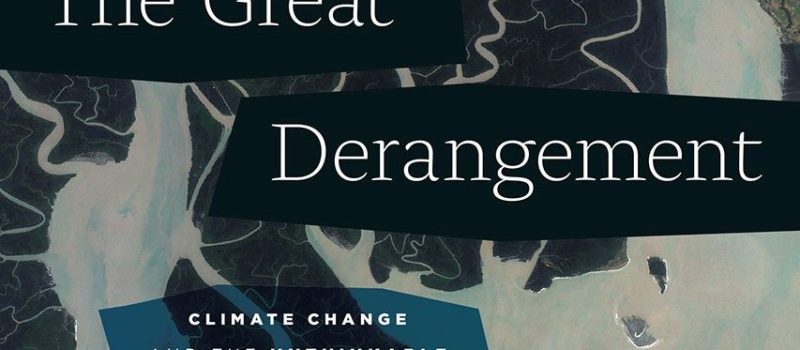
Amitav Ghosh, ‘The Great Derangement: Climate Change and the Unthinkable’ (Chicago, IL: University of Chicago Press. 176pp.)
1 October 2026, roughly an 8-minute read
This essay continues my series of monthly posts in which I select one ‘climate’ book to highlight and review from one of the 44 years of my professional career in climate research (starting with 1984, my first year of academic employment). The series will end in September 2027, the month in which I shall retire. See here for more information about the rational for this series, and the criteria I have used in selecting my highlighted books.
This ‘2016 essay’ can be download as a pdf.
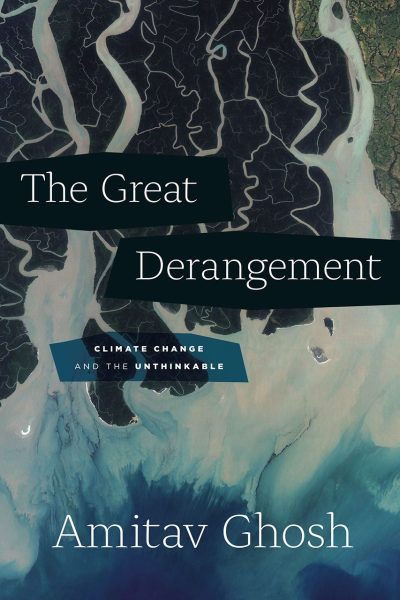
In an interview published in 2002, the 46-year-old Indian writer and novelist, Amitav Ghosh, was asked to reflect on his various writing styles. “I haven’t written in so many genres … I’ve written novels and I’ve written non-fiction—my reportage. And frankly, I don’t even think of them as different genres in some way”.[1] Ghosh had written novels—such as ‘The Circle of Reason’ (1986) and ‘The Glass Palace’ (2000)—and non-fiction, such as a collection of essays ‘Dancing in Cambodia and at Large in Burma’ (1998). In his interview, he remarked on the similarities between the two modes of writing and the cross-over techniques that he deployed in both. “In the end,” he said, “it’s about people’s lives; it’s about people’s history; it’s about people’s destinies. When I write non-fiction, I’m really writing about characters and people, and when I’m writing fiction, I’m doing the same thing.” This insight helps us understand Ghosh’s later literary engagement with the idea of climate change.
Amitav Ghosh was born in 1956 in West Bengal where his father had worked in the British-Indian Army. He adopted New York as his writing base in 1993, which is where, for example, in the years between 2004 and 2015 he worked on his fictional Ibis trilogy, which revolved around the origins and implications of the First Opium War (1839 to 1842). The first instalment in this trilogy, ‘Sea of Poppies’, was shortlisted for the 2008 Man Booker Prize, the year after the Government of India had awarded Ghosh the civilian honour of Padma Shri, recognition for a distinguished contributions to the arts, education, industry, literature, or science.
By 2015 therefore, Amitav Ghosh, now 60, was a prolific, successful, widely recognised and frequently feted Indian author writing in the English language. His novels adopted complex narrative strategies, exploring questions of national and personal identity in colonial and post-colonial South Asia. But in the autumn of 2015, his writing was to take a new turn. Ghosh was invited by the University of Chicago to deliver the Randy and Melvin Berlin Lectures and he took as his theme ‘The Great Derangement: Fiction, History, and Politics in the Age of Global Warming.’ These four lectures explored the literature, history and politics of climate change and the public response of writers to this great matter of public concern. Ghosh’s talks were published the following year by the University of Chicago Press under the revised title ‘The Great Derangement: Climate Change and the Unthinkable’ and I have selected this as my 2016 Climate Book of the Year.
‘The Great Derangement’ was divided into three parts: Stories, History and Politics. Ghosh began by arguing that climate change was not so much a crisis of science, technology and economics as it was a crisis of the imagination. He identified as a problem the increasing self-reflexivity of the ‘realist’ novel, which therefore mostly ignored the communal events of history, politics and nature. Such fictional narratives, argued Ghosh, were incapable of supplying the imaginative resources needed to deal with climate change. In the History section, his post-colonial instincts came to the fore. He argued that imperialism had been as important as capitalism in feeding the underlying forces of fossil fuel expansion and exploitation. And in the final section—Politics—Ghosh identified the two most important political hallmarks of modernity as being economic growth and the search for “personal authenticity, a journey of self-discovery.” Climate change, he concluded, posed a powerful challenge to this self-directed journey. [p.119]
‘The Great Derangement’ was therefore an extended essay about the relationship of literature to science, history and politics, at the heart of which was Ghosh’s recognition that climate change presented literary realism with a formidable challenge. Why were humanists, especially literary writers, he asked, seemingly reluctant to engage directly with climate change? For Ghosh, this reluctance was part of a broader pattern of indifference and misrepresentation.[2] Contemporary arts and literature were characterized by “modes of concealment that [prevent] people from recognizing the realities of their plight.”
The success of the modern novel in its realist genre lay in capturing the everyday realities and experiences of the human subject. But Ghosh argued that the emphasis on order, uniformity, predictability and human agency that lay at the heart of the realist novel—from the nineteenth century onwards—sat uneasily with the extra-human and unsettling scalar characteristics of climate change. The literary realist assumption of human mastery of nature could no longer be assumed. Ghosh wanted to see contemporary fiction take on the challenge of embracing the vast and disorienting scales of time and space over which climate change unfolded while, at the same time, making these scales tangible through narratives which related to readers’ everyday lives.
‘The Great Derangement’ was therefore also a call to creative writers to rise to this task,
The great, irreplaceable potentiality of fiction is that is makes possible the imagining of possibilities. And to imagine other forms of human existence is exactly the challenge that is posed by the climate crisis: for if there is any one thing that global warming has made perfectly clear it is that to think about the world only as it is, amounts to a formula for collective suicide. [p.128]
Ghosh offered speculative fiction as a possible response to this challenge. Speculative fiction may not in any direct material sense change the course of future climate, he wrote, but it could perhaps address what he diagnosed as a “lack of imagination” he observed in the climate change discourse about the possibilities of change.
Ghosh’s challenge to creators of literary fiction paralleled one that had been issued to historians a few years earlier by another member of the Indian academic diaspora, Dipesh Chakrabarty. Chakrabarty, Professor of History, South Asian Languages and Civilizations at the University of Chicago since 1995, was a leading scholar of postcolonial theory and subaltern studies. In an influential article written in 2009, he had argued that climate change required historians to re-imagine their writing of the past by “thinking simultaneously” about “the chronologies of [both] capital and species history.” In other words, human history and planetary history are deeply entangled. Such a task, wrote Chakrabarty, “stretches, in quite fundamental ways, the very idea of historical understanding.”[3]
In the view of some reviewers, Ghosh landed his argument “provocatively” at the end of ‘The Great Derangement’. He lauded the animating power and moral energy for attending to climate change that could emerge from religious narratives and movements. For example, reviewing for The Guardian newspaper historian Fredrik Albritton Jonsson wrote that Ghosh’s argument carried him “from the birth of the novel to the industrialization of Asia, from the environmental politics of the military security state to, in a move that might surprise some observers, an examination of how organized religion might take the lead in promoting future mitigation efforts.”
Unlike many secular thinkers such as Naomi Klein, Ghosh proposed that without the animating power of religion—and its sense of the sacred—there was little hope for developing any adequate response to the dangers of climate change. “The most promising development, in my view, is the increasing involvement of religious groups and leaders in the politics of climate change.” [p.159] Organisations with “religious affiliations possess the ability to mobilize people in far greater numbers than any others.” [p.160] It was noteworthy that the book appeared the year after Pope Francis’ rallying cry to Roman Catholics and “all people of good will” to embrace the relevance, vitality, and inspiration of a Christian worldview for dealing with “the ecological crisis.”
‘The Great Derangement’ was as close as one could get to a literary celebrity asking why serious novelists didn’t take climate change seriously as the subject for their work. Unsurprisingly therefore, the book was reviewed widely in literary journals and public media around the world, including for the ‘British Society for Literature and Science’, ‘The London Review of Books’, ‘The Wire’, ‘The Guardian’, ‘Green Christian’, ‘The Times of India’, ‘Mekong Review of Asian Literature’, the ‘Los Angeles Review of Books’. And the list went on. Even the scientific journal Nature gave the book a call out. Its reviewer wrote, “Branding our era of denial and inertia ‘the Great Derangement’, Ghosh looks in turn at literature, history and politics to examine this failure … The solution, he argues, lies in … a resurgence in our imaginative capacity to envision human existence anew.”[4]
Exemplifying the depth of this engagement, the Journal of Asian Studies published a roundtable discussion about the book between Ghosh and five US-based historians: Julia Adeney Thomas, Prasannan Parthasarathi, Rob Linrothe, Fa-ti Fan, and Kenneth Pomeranz. Responding to the admiration, and criticisms, of this panel, Ghosh revealed more about his motivation for writing the book. It was, first and foremost, to issue a challenge to altruistically minded people—especially those in the west—about whether they would “be willing to sacrifice influence and power” to tackle climate change.[5] Taking action on climate would mean a radical restructuring of global power, said Ghosh, something which in his view the dominant nations in the global system had resisted. This sharper edge to the critique proffered in ‘The Great Derangement’ was picked up by the book’s reviewer in the ‘Mekong Review’, an Asian literary magazine. Ghosh’s book, wrote Michael Freeman, “is a tract for the times, a polemic against the political inertia of the international order and its disorders. But for all the urgency of its case, it’s a measured and judicious, soberly annotated exposition.”[6]
‘The Great Derangement’ quickly became an important text in literary studies, adopted in seminars and student classes around the world. It has influenced a new generation of students and writers. In the decade or so since publication, the book has been cited over 4,000 times according to Google Scholar, with citations still accruing at the rate of 15 per week. And in 2021, Penguin Random House included an extract from ‘The Great Derangement’ in their pocket-book series ‘Green Ideas.’[7]
The years since writing ‘The Great Derangement’ brought Ghosh further public recognition and a slew of new awards. In 2018, he received the 54th Jnanpith award, becoming the first English-language writer to receive India’s highest literary honour. And in 2019, the US-based Foreign Policy magazine named him one of the most important global thinkers of the preceding decade. ‘The Great Derangement’ also reshaped Ghosh’s own writing career. He subsequently published two books—the novel ‘Gun Island’ (in 2019) and the non-fiction ‘Nutmeg’s Curse’ (2021)—which were his literary response to the challenge he had issued to others to write more powerfully, and less solipsistically, about climate change
© Mike Hulme, October 2026
Subscribe to our newsletter!
Other significant books published in 2016
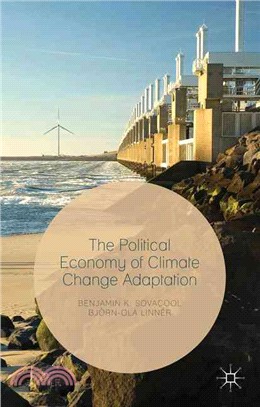
Benjamin K Sovacool & Bjørn-Ola Linnér, ‘The Political Economy of Climate Change Adaptation’ (London: Palgrave MacMillan. 226pp.)
When climate change first emerged in the late 1980s as a major international public policy challenge, the dominant question being asked was how to limit, and how quickly to limit, emissions of the greenhouse gases into the global atmosphere. This challenge was referred to as ‘climate mitigation’ and the 1997 Kyoto Protocol was designed accordingly. Into the new century however, a second strand of policy responses to climate change—one that had always been present, although muted—began to gain greater prominence: ‘climate adaptation’. Mitigation sought to minimise the extent of change; adaptation, to minimise the damage and danger caused by whatever residual change in climate would remain. By the 2010s, new international climate finance was being mobilised to support climate adaptation and the associated ‘loss and damage’ policy agenda. But adapting to climatic hazards was a multi-scale activity, engaging the smallest local landholder, national schemes of coastal protection, and international financing of large infrastructure projects.
Benjamin Sovacool and Bjørn-OlaLinnér’s 2016 book, ‘The Political Economy of Climate Change Adaptation’, was far from being the first on the topic of climate adaptation. But it was a significant contribution since it explored the challenges and risks of climate adaptation through a political economy lens. That is, they explained the economics of climate adaptation in relation to political, legal, and institutional structures of power. Sovacool (an American-British energy economist) and Linnér (a Swedish policy analyst) identified four processes that frequently distorted the goals of climate adaptation—enclosure, exclusion, encroachment and entrenchment. They illustrated these processes at work through four cases studies drawn from Bangladesh (concerning land tenure), the Netherlands (coastal protection), the US (hurricane recovery), and the international mechanisms of the UNFCCC (financing and climate diplomacy).
Adapting to (changing) climatic hazards in a myriad of different ways has always been a feature of human societies. It is needed even more in today’s world. But as Sovacool and Linnér showed in this book, adaptation is also always a political process—creating winners and losers—and always at risk of resulting in maladaptation.
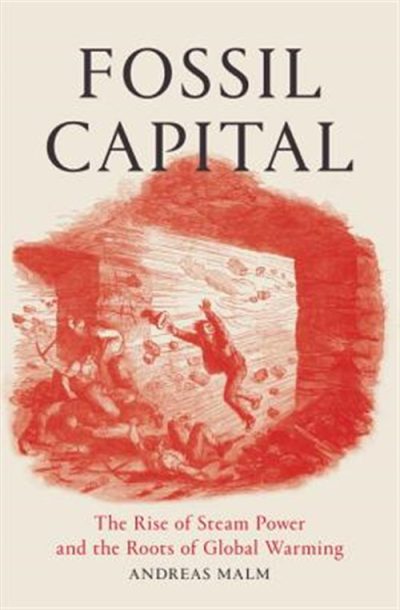
Andreas Malm, ‘Fossil Capital: The Rise of Steam Power and the Roots of Global Warming’ (New York: Verso. 496pp.)
As with several of the ground-breaking books reviewed in this series, Andreas Malm’s ‘Fossil Capital’ started life as a PhD thesis, in this case awarded to him in 2014 by the University of Lund in Sweden. Before turning to academic study, Malm had worked as a journalist and had been active in the Swedish Anarcho-Syndicalist Youth Federation. An unashamed Marxist, Malm approached his study of the industrial roots of global warming through the lens of political ecology. This theoretical stance rejects the idea that environmental changes are purely natural and seeks to unveil the underlying relationships between political, economic and social factors and their environmental repercussions.
In ‘Fossil Capital: The Rise of Steam Power and the Roots of Global Warming’, Malm placed the origins of climate change in the emergence of fossil capitalism in the late eighteenth and early nineteenth centuries and the turn to steam power in the Industrial Revolution, especially in England. Malm pointed to how the totality of events in the history of fossil capitalism are now infused with significance that would have astonished the steam engineers and cotton factory owners in Britain at the beginning of the nineteenth century. He drives his argument forward by stating that climate change “is a lifting of the veil on two centuries of fossil capitalism … a truth [that] has been hidden from view.” [p.393] As political ecologists frequently do, Malm criticised the flattening of human culpability for climate change that is promoted through one reading of the idea of the Anthropocene, ‘the era of humans’. The physical logic of cause and effect—“the smallest puff of smoke in Manchester in 1842 released a quantity of CO2 which then lingered in the atmosphere, playing a microscopic part in the creation of the current climate” [p.5]—must not let off the hook the powerful political actors, past and present, who had made their wealth on the back of fossil carbon.
The book’s argument might have started in England in the early nineteenth century, but it ended in China in the early twentieth century when China became the world’s top carbon emitter around 2006. In Malm’s reading, this reflected capital’s globally-mobile “search for cheap and disciplined labour power by means of the massive consumption of fossil energy: the latest twist in an old story.”[8] Malm’s Marxist leanings were clear in his prognosis. Only a radical overthrow of the current economic order would suffice. It is not surprising that Malm’s ‘Fossil Capital’ had a significant influence on the radical activist Naomi Klein, who identified his bookas providing “the definitive deep history on how our economic system created the climate crisis” [blurb].
Malm, currently Senior Lecturer in human ecology at Lund University, subsequently wrote a series of books which developed his core themes, all published by the left-radical Verso Press. The two most recent ones have been ‘Overshoot: How the World Surrendered to Climate Breakdown (2024) and, with his colleague Wim Carton, ‘The Long Heat: Climate Politics When Its Too Late’ (2025).[9] To mark the tenth anniversary of ‘Fossil Capital’, Malm was interviewed in January 2026 for the journal Cultural Studies about the arguments and impact of the book, the development of his thought in his subsequent books, and the shifting landscape of climate politics. The instigators of this interview may be correct when they wrote that ‘Fossil Capital’ “reshaped how scholars understand the relationship between capitalism and fossil fuels.” However, the last ten years have shown that it takes more than a Marxist academic to change the world.
[1] Ghosh, A. and Aldama, F.L. (2002) An intervíew wíth Amitav Ghosh. World Literature Today. 76(2): 84-90.
[2] Jonsson, F.A. (2016) ‘The Holocene hangover: it is time for humanity to make fundamental changes’ The Guardian. 7 December
[3] p.220 in: Chakrabarty, D. (2009) The climate of history: four theses. Critical Inquiry. 35 (Winter): 197-222.
[4] Kaiser, B. (2016) Books in brief. Nature. 538: 169. 12 October.
[5] p.952 in: ‘Round Table on Amitav Ghosh, The Great Derangement: Climate Change and the Unthinkable.’ Journal of South Asian Studies. 75(4): 929-55.
[6] Freeman, M. (2017) Narrative change. Mekong Review. 7(2). April.
[7] Ghosh, A. (2021) Uncanny and Improbably Events. London: Penguin Random House. 116pp.
[8] Review by John Tomaney for the LSE Review of Books, 17 June, 2017.
[9] Prior to these, his other books were: The Progress of This Storm: Nature and Society in a Warming World (2018); Corona, Climate, Chronic Emergency: War Communism in the Twenty-First Century (2020); and How to Blow Up a Pipeline: Learning to Fight in a World on Fire (2021).