
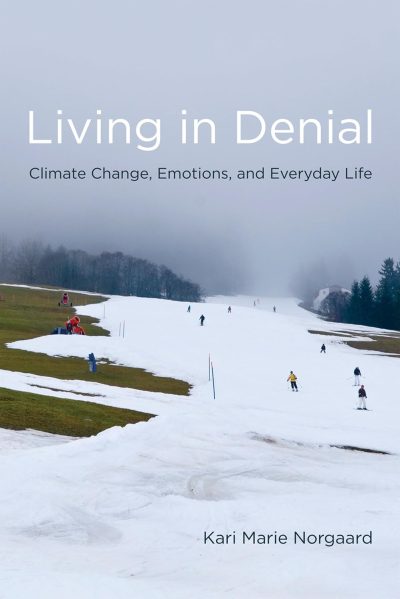
Kari M. Norgaard, ‘Living in Denial: Climate Change, Emotions and Everyday Life’ (Cambridge, MA: MIT Press. 279pp.)
This essay continues my series of monthly posts in which I select one ‘climate’ book to highlight and review from one of the 44 years of my professional career in climate research (starting with 1984, my first year of academic employment). The series will end in September 2027, the month in which I shall retire. See here for more information about the rational for this series, and the criteria I have used in selecting my highlighted books.
This ‘2011 essay’ can be download as a pdf.
By 2011, the language of climate contrarianism, scepticism and denialism was widely used in public and political disputations about the realities of climate change and about how individuals and societies should respond. For some academics, commentators and campaigners, the cause of such attitudes was the malicious influence of the fossil fuel industry or of right-wing libertarian think-tanks. Such actors, so it was claimed, were misleading people about the science of climate and about the evidence for human influence on the climate system, thereby undermining people’s support for climate policies.
These arguments leant heavily on the assumption of enlightened rationality. Scientific ‘facts’, properly communicated to audiences—without the contamination of misinformation from bad faith actors or the distorting lenses of ideologically driven media—provided the necessary and sufficient motivation for citizens to take virtuous actions in their own lives and to lend support to well-meaning policies initiated by their governments. Two books reviewed earlier in this series—Gelbspan’s ‘The Heat Is On’ (from 1997) and Oreskes and Conway’s ‘Merchants of Doubt’ (2010)— advanced this explanation for public apathy, scepticism or resistance to individual or collective behaviour change.
The assumption of enlightened rationality fed the ‘information deficit model’ of science communication. This ‘model’ had proved very difficult to dislodge, despite more than two decades of research which showed that this was not how most people thought or acted in everyday life. Writing a few years later, in 2016, Argentinian sociologist Carina Cortassa offered a reason for the tenacity of the deficit model among policy advocates and campaigners: “The hypothesis [that] the lack of knowledge among laypeople … prevails because it is an intuitive and optimistic way to frame the gap between science [knowledge] and society [action] and, therefore, to cope with its causes and consequences.”[1]
Whatever the merits or otherwise of the information deficit model, it was quite clear by 2011 that reducing emissions of greenhouse gases to limit the extent of future climate change was proving much, much harder than the early climate campaigners of the 1990s and 2000s had imagined and hoped for. Simple single-cause explanations—such as blaming disingenuous oil and gas companies for sowing confusion—for public recalcitrance in supporting climate policies might galvanise protests against such corporate interests and signal virtue among the protesters. But such explanations were inadequate to account for individual behavioural and collective political inertia. Others recognised the more subtle range of factors that influenced human attitudes and behaviour with respect to climate change. Psychologists, anthropologists and sociologists had been undertaking sustained research about people’s engagement with climate change for a decade or more and in 2011 a book was published which brought to a wider audience some of this grounded ethnographic research about climate scepticism and public quietism. My 2011 Climate Book of the Year is therefore Kari Norgaard’s ‘Living in Denial: Climate Change, Emotions and Everyday Life.’
Kari Marie Norgaard (born 1968) trained in biology and sociology and was first introduced to climate change through an undergraduate course she took as a biology student in 1988. Following her master’s degree in sociology, she embarked on a PhD in the late 1990s which was awarded in 2003 from the University of Oregon. ‘Living in Denial’, was based on this PhD thesis, grounded in fieldwork undertaken by Norgaard in Norway during 2000 and 2001. After a series of subsequent academic positions elsewhere in the USA, she returned to Oregon in 2011 as professor of sociology where she continues to publish and teach today.
Norgaard’s choice of Norway in which to study climate apathy resulted from a combination of personal circumstances and professional interests. “I am a third generation Norwegian-American,” Norgaard told me, “whose pre-existing ties gave me insight into many of the circumstances [of climate apathy] as well as proficiency in Norwegian. Since the time I first lived in Norway as a teenager in the 1980s, I had been fascinated by the extent of progressive environmental policy and awareness there.” There were also good sociological reasons why Norway was a good place to find answers to the questions Norgaard was asking. “Norway has one of the highest standards of living in the world, was at the time tied with Japan for the highest per capita newspaper readership, had at the time widespread belief that climate change was occurring and high percentages of Norwegians vote and are active in local politics … Norwegians have been proud of their close relationships to nature, their native environmentalism, and their leadership role on global environmental issues, including climate change. If any nation could find the ability to respond to this problem, we might imagine it to be a place like Norway, where the population is educated, cared for, politicized, and environmentally engaged.”
For ten months over the years 2000 and 2001 Norgaard lived in a rural township of about 12,000 people in western Norway, where she undertook ethnographic research. She adopted the pseudonym ‘Bygdaby’ to describe the township, the word meaning in Norwegian a settlement between a village and a city in size. Norgaard explained that it was small enough “to get a sense of a cross section of experiences, and large enough that it hosted the range of active political parties … My status as an outsider made it easier for me to ask basic questions about social life and practices and more acceptable for me to voice such questions them to others.”[2]
Norgaard wanted to find out why people appeared so apathetic towards climate change, even when they were very well-informed about it. Her informants could visibly see some of its consequences—by chance the year she was there included an unusually warm winter. Stories in local and national newspapers linked the warm winter explicitly to global warming. Yet residents did not write letters to the editor, pressure politicians, or cut down on their use of fossil fuels. Far from being under the influence of nefarious political actors, “… people [in Bygdaby] are so sincere in their concerns for the wider world and engaged in so much political activity on its behalf.” [p.ix]
Norgaard noticed the disturbing emotions of guilt (bound up with people’s identity), helplessness (bound up with ideas of efficacy) and fear of the future (bound up with their sense of security) that arose when people were confronted with the idea of climate change. Lack of knowledge was not the issue. Rather it was the inability to connect abstract knowledge with everyday experience and hence not knowing what to do. The result was climate apathy. Based on these observations, and using insights from the sociology of emotions, environmental sociology and the sociology of culture, Norgaard developed her model of “socially organized denial.” This described how people normalized these disturbing emotions through conversational norms and discourses that served as “tools of social order.” [p.171]
Norgaard had been promoting this model for several years before the book was published. For example, in November 2007, in an on-line column—‘Understanding the Climate Ostrich—for the BBC news website she wrote, “Why do people find it hard to accept the increasingly firm messages that climate change is a real and significant threat to livelihoods?” She dispensed with the “dominant explanation within my field of environmental sociology” that people failed to react constructively because they were too poorly informed or suffered from incorrect mental models. She also suggested that the psychological theory of “confirmation bias”, whereby people only seek out information that supports their prior beliefs, was an insufficient explanation. The evidence laid out in ‘Living in Denial’ challenged these rational cognitive explanations. The people of Bygdaby were not ill-informed or misinformed. In fact, they were very well-informed and yet showed declining interest in the issue for reasons far removed from the misinformation of bad faith actors or the ideological biases of a deceitful media.
Norgaard’s close and empathetic analysis of the people of Bygdaby showed that the ‘social organisation of climate denial’ resulted from a situation where “global warming is an issue about which people care and have considerable information, but one about which they don’t really want to know and in some sense don’t know how to know.” Her work turned upside down the conventional understanding of the causes of climate apathy. Rather than being the result of impaired understanding or insufficient care about changing ecological conditions and our human neighbours, Norgaard explained that “these qualities are acutely present but actively muted [so as] to protect individual identity and sense of empowerment, and to maintain culturally produced conceptions of reality.” [p.207]
‘Living in Denial’ attracted reviews across a wide range of academic social science journals and in some more popular media outlets such as the Bergen Times in Norway.[3] In her review, Ruth Greenspan Bell explained how Norgaard approached climate policy failures through the lens of human instincts and loss aversion. Her book “unpacks the conflict between values, which include living modestly and a profound engagement with nature, and [people’s] comfortable, fossil-fuel-supported lives. The bottom line is that people’s current needs, desires and security overshadow the less coherent and pressing concerns about the future.”[4] Reviewing for Nature Climate Change, I concluded that,
…the problem of climate change is not really about climate change at all; rather “[climate change] provides a window into a wholly new and profound aspect of the experience of modern life”. When engaging with the idea of anthropogenic climate change, people find new contradictions emerging between knowledge, values and actions—and they also find that there are no easy ways of resolving them.[5]
Norgaard gave many talks about her work in subsequent years, including this very good summary in a 2014 talk delivered to a conference in Iceland. The book has been widely cited in academic literature, recording a total of 2,400 Google Scholar citations to date and still on a rising trajectory, receiving nearly 300 in 2025.
A decade had passed between Norgaard’s PhD fieldwork in 2000/01 and the book’s publication, but when published in 2011 ‘Living in Denial’ was an original and timely intervention. It arrived at a moment when analysts and policy specialists were looking for deeper and more convincing answers to the widespread existence of climate apathy amongst the population at large, despite public polling that showed widespread acceptance of the scientific evidence for human influence on climate. ‘Living in Denial’ was an early example of a new range of studies that would explain the relationship between action and inaction, between belief and doubt, using more sophisticated arguments than the simple, and misleading, one that virtuous individuals had been brainwashed by bad people. The book’s insights about the complex and subtle social, cultural and psychological reasons why people’s engagement with the changing climate is so varied remain relevant and valuable today.
© Mike Hulme, May 2026
Subscribe to our newsletter!
Other significant books published in 2011
Maxwell T. Boykoff, ‘Who Speaks for the Climate? Making Sense of Media Reporting on Climate Change’ (Cambridge: Cambridge University Press. 228pp.)
From the earliest years of public concern about the prospect of significant human influence on the climate, the media have been important in interpreting the science, politics, economics and ethics of the issue. Steve Schneider, whose autobiography I reviewed earlier, was a master of media engagement from the 1970s onwards and people such as Bill McKibbin, Ross Gelbspan, and Fred Pearce made their names as prominent climate journalists. Public media—traditionally newspapers, TV and radio; more recently blogs, YouTube, and TikTok—play important roles in climate change messaging, shaping narratives, instilling meaning, and enrolling publics. Max Boykoff’s 2011 book, ‘Who Speaks for the Climate? Making Sense of Media Reporting on Climate Change,’ was the first full-length systematic treatment of (mostly) English language newspaper reporting of climate change—he included some limited coverage of TV and new social media—tracking back into the early 1990s.
At the time of writing, Boykoff was in his late 30s and an assistant professor in environmental policy research at the University of Colorado in Boulder. He had risen to prominence a few years earlier with his first academic publication, co-written with his brother Jules, which had investigated climate change stories in the United States’ prestige press between 1988 and 2002. The Boykoff’s framed their analysis using the idea of “balance as bias.” By this they meant that by adhering to the journalistic norm of ‘balanced coverage’, press coverage tended to unduly weight the views of a small number of climate sceptical scientists. Coverage of the issue might thus be ‘balanced’, but in effect became ‘biased’.[6] By the late 2000s, Boykoff—now working on his own—had developed and extended this analysis, and explored other journalistic themes in climate change reporting, all of which contributed to his 2011 book. It also led him to create what he called his on-line ‘Media and Climate Change Observatory’, which provided a lot of data for the book. He has faithfully maintained this ‘observatory’ since 2009.
‘Who Speaks for the Climate’ appeared around the time when many people were beginning to rely predominantly on on-line news and social media sources. Boykoff is alert to these new possibilities. In his final chapter he explored some of the implications of this development for climate change communication, public understanding and collective action, but also some of the dangers of such new social media for the future health of democracy.
David Victor, ‘Global Warming Gridlock: Creating More Effective Strategies for Protecting the Planet’ (Cambridge: Cambridge University Press. 392pp.)
In May 2011, Russia and Canada announced that they would not subscribe to a second commitment period of the Kyoto Protocol, due to take effect from 2013. In this, they followed Japan’s lead from the previous December. At the time, the Protocol was the only game in town with respect to an international climate treaty. The world’s largest economy—the United States—had never ratified even the original Protocol, but now the withdrawal of these three significant economies finally hammered down the nails on the coffin of Kyoto. The world was at gridlock on climate change. Fortunately, a few months earlier, in March 2011, David Victor, a political scientist at the University of California, San Diego, had published a trenchant analysis of what had gone wrong and why. The book was ‘Global Warming Gridlock: Creating More Effective Strategies for Protecting the Planet’.
Victor had been studying and writing about international relations for the previous two decades, especially with respect to environmental regulation, energy markets and international law. He had long been warning that the logic behind the Kyoto Protocol, derived from the relatively successful 1987 Montreal Protocol, was deeply flawed with respect to climate change and doomed to fail. Now, as the world had to confront this failure, Victor offered a masterful dissection of the reasons why, together with a clear-sighted outline of a better way for tackling climate change. Victor’s proposal was to sideline the United Nations in favour of a smaller group of countries comprising both ‘committed’ and ‘large recalcitrant’ economies. Negotiating within such ‘climate clubs’ was the way forward, he argued, not trying to do so among 196 nations, many of whom had tiny populations and even smaller economies. The climate clubs would operate a pledge-and-review system, offering nationally determined policies in line with their own interests. The blurb for the book explained—“[the] roadmap to a lower carbon future [should be] based on encouraging bottom-up initiatives at national, regional and global levels, leveraging national self-interest rather than wishful thinking.”
Victor’s pragmatism made some ground at the subsequent COP21 negotiations that produced the 2015 Paris Agreement. A bottom-up architecture was agreed, in which nations would put forward their own “nationally determined contributions”. But Victor’s other suggestions were ignored. Instead, a fantastical top-down temperature target (1.5°C) was foregrounded and his ‘climate clubs’ idea sidelined in favour of the lugubrious machinations of the fully constituted UN. Over the years, Victor has continued to make the case for a more realist approach to climate strategy, for example co-authoring with Charles Sabel ‘Fixing the Climate: Strategies for an Uncertain World’ (Princeton University Press, 2022).
[1] Cortassa, C. (2016) In science communication, why does the idea of a public deficit always return? The eternal recurrence of the public deficit. Public Understanding of Science. 25(4): 447-459.
[2] Norgaard, K.M., pers. comm., February 2026.
[3] For example, reviews of the book appeared in ‘Global Environmental Politics’, ‘Contemporary Sociology’, ‘Ecological Economics’, ‘Environment’, ‘Science of the Total Environment’, ‘Organization and Environment’, ‘Ecopsychology’, ‘Alternatives Journal’, ‘Race, Gender & Class’, ‘International Dialogue’.
[4] Bell, R.G. (2012) Review of ‘Living in Denial: Climate Change, Emotions and Everyday Life.’ Review of Policy Research. 29(1): 169-70.
[5] Hulme, M. (2011) A town called Bygdaby. Nature Climate Change. 1(2): 83. April.
[6] Boykoff, M.T. and Boykoff, J.M. (2004) Balance as bias: global warming and the US prestige press. Global Environmental Change. 14: 125-136.