
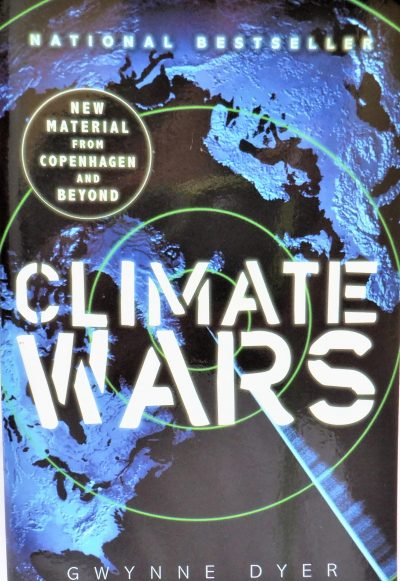
Dyer,G. (2008) Climate Wars: The Fight for Survival as the World Overheats. Toronto: Random House. 272pp.
This essay continues my series of monthly posts in which I select one ‘climate’ book to highlight and review from one of the 44 years of my professional career in climate research (starting with 1984, my first year of academic employment). The series will end in September 2027, the month in which I shall retire. See here for more information about the rational for this series, and the criteria I have used in selecting my highlighted books.
This ‘2008 essay’ can be download as a pdf.
In October 2003, six months after the US-led invasion of Iraq, the Pentagon published a short study titled ‘An Abrupt Climate Change Scenario and its Implications for US National Security’. It was written for the United States’ Department of Defense by two consultants, Peter Schwartz and Doug Randall, and it presented a grim future of warring states and massive social disturbances resulting from climate change. At a time when the US military were heavily committed to operations in Afghanistan and Iraq, it was an early foray by the Pentagon into trying to understand the significance of climate change for American national security. A few years later, in 2007, the UN Secretary-General Ban Ki-moon, picked up the trope of climate and warfare in a short, but widely publicised, article ‘A Climate Culprit In Darfur’. The brutal civil war that was then raging in western Sudan had diverse social and political causes, said Ki-moon, “but the Darfur conflict began as an ecological crisis, arising at least in part from climate change”. He was taking his cue from a recently published UNEP report, ‘Sudan Post-Conflict Environmental Assessment.’
Ban Ki-moon’s article appeared as an op-ed in the Washington Post in June 2007 and his claims were quickly challenged in the pages of the journal Nature.[1] Experts on Sudan noted “This is not about competition over resources”, placing the blame not on climate but on the militaristic National Islamic Front which was bent on expanding its political base though ethnic cleansing, using terror as a tactic. And the evidence for UNEP’s ‘climate change-conflict’ thesis was scant. An academic review article that pre-dated Ki-moon’s article was highly sceptical of the thesis, concluding that “the causal chains suggested in the literature have so far rarely been substantiated with reliable evidence.”[2]
Nevertheless, the story rapidly circulated around the digital world. A few days after the Washington op-ed, The Guardian newspaper ran a piece under the banner, “Darfur conflict heralds era of wars triggered by climate change, UN report warns”, further amplifying Ban Ki-moon’s message by stating “The conflict in Darfur has been [sic] driven by climate change and environmental degradation, which threaten to trigger a succession of new wars across Africa unless more is done to contain the damage.” ‘The First Climate Change Conflict’ (from the World Food Program, USA) was just one example of the many subsequent headlines about the Darfur civil war and which contributed to establishing in the public imagination that climate change would lead to an upsurge in wars.
The 9/11 attacks on the USA in 2001, the Pentagon’s 2003 report and Ki-moon’s influential intervention in 2007 mobilised a new linguistic repertoire for describing climate change. In the era of George W Bush’s “war on terror”, climate change came to be viewed as “more serious even that the threat of terrorism”, as “a weapon of mass destruction”, as demanding a “war on global warming to replace that on terror”, and as “the ticking clock” to replace the spectre of nuclear holocaust.[3] In the aftermath of Ban Ki-moon’s intervention I wrote about this new discourse of climate and conflict for the news-site ‘OpenDemocracy’, alluding to “the seduction of [a new form of] climate determinism [that] has been underway for several years.”
In was at this moment, in 2008, that a book was published by a leading military journalist and analyst of international affairs which ramped up another notch the ‘climate wars’ rhetoric. Gwynne Dyer’s ‘Climate Wars: The Fight for Survival as the World Overheats’ reflected this new febrile mood about climate change and I have therefore selected it as my 2008 Climate Book of the Year. Dyer (b.1943) is a Canadian military analyst and historian, a journalist and columnist. In his earlier years, he’d worked with the navies of Great Britain, Canada and the US, and gained a doctorate in Military and Middle Eastern History from the University of London. By 2008, the 65-yr old was a widely read public analyst of international military and strategic issues and the author of two books about the Iraq war: ‘Ignorant Armies: Sliding into War in Iraq’ (McClelland & Stewart, 2003) and ‘The Mess They Made: The Middle East After Iraq’ (2007).
‘Climate Wars’ was originally published in Toronto, by Random House, and deals with the geopolitical implications of large-scale climate change. Dyer set out the purpose of his book in sober terms. ‘Climate Wars’ is “about the political and strategic consequences of climate change,” he wrote, based on secondary sources—the 2006 Stern Review, the IPCC’s Fourth Assessment Report (2007), and a number of “interviews with scientists, soldiers, bureaucrats and politicians” [p.xii]. Dyer uses speculative scenarios as his narrative device—his attempt to “peer through a glass darkly” to help his readers “understand the politics of the potentially apocalyptic crisis that looks set to occupy most of the 21st century” [p.xi].
The book is scaffolded around eight unsettling scenarios, set respectively in the 2010s, 2019, 2029, 2036, 2042, 2045, 2055 and 2175. Each fictional scenario depicts the consequences of different imagined climate-induced catastrophes: for example, a US border fence with Mexico in 2029, the collapse of China’s agriculture in 2042, a Pakistan-India nuclear war in 2036, and human wipeout in 2175. This final scenario, even for Dyer, is “too melodramatic, too apocalyptic” and he pretends not to write it. [p.252] His journalistic descriptions of each imagined scenario are followed with a subsequent chapter which brings the reader back to the present. In this chapters, Dyer discusses and evaluates different political or strategic interventions being contemplated at the end of the 2000s decade.
The book is blurbed on the cover by, among others, two authors whose writings I have previously reviewed in this series, Crispin Tickell and James Lovelock. Tickell sees ‘Climate Wars’ as “A lively, alarming and even entertaining attempt to look ahead … we need hope as well as good sense in looking at the future”, while Lovelock concludes that “Dyer has made the best and most plausible set of guesses I have yet seen about the human consequences of climate change.” Dyer’s lurid scenarios—his “guesses” about these consequences—feature prominently in the book’s advertorial on Amazon,
… a terrifying glimpse of the none-too-distant future, when climate change will force the world’s powers into a desperate struggle for advantage and even survival. Dwindling resources. Massive population shifts. Natural disasters. Spreading epidemics. Drought. Rising sea levels. Plummeting agricultural yields. Crashing economies. Political extremism. These are some of the expected consequences of runaway climate change in the decades ahead, and any of them could tip the world towards conflict.
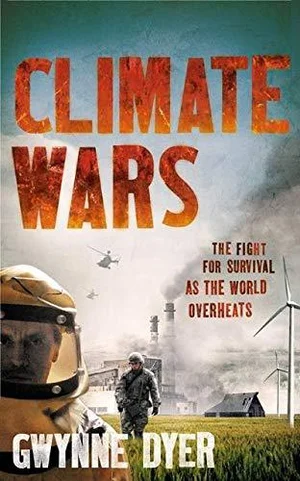
The initial reception of the book was relatively muted and initially had limited exposure within the mainstream academic literature. But prompted by a three-part Canadian Broadcasting Corporation radio series and an international speaking tour, Dyer issued a slightly revised edition of the book in 2010, this time with two publishing houses possessing greater international reach: OneWorld Publisher (Oxford) and Scribe (New York). (The 2010 cover is shown here). The 2010 edition of ‘Climate Wars’ now gained greater world-wide attention and it is this edition that is usually referred to in the literature. For example, Fred Pearce reviewed the second edition for New Scientist in April 2010 under the headline ‘The climate-change nightmares of military strategists’, and in 2011 Edgar Goell reviewed it for the social science journal Critical Policy Studies.[4]
In a talk delivered several years later at Carleton University in his native Canada, Dyer explained the background to his book. He had long-wanted to write about climate change from a military perspective, he said, and explained that “military planners anticipate [that] the climate crisis will increase unrest and force powerful western nations to become brutal in the defence of their own people; to the point of shooting people who try to cross borders illegally”. Part of Dyer’s reason for portraying the issue in such stark terms was, as he put it, to “get the donkey’s attention.” Or as Goell, a futures analyst, states in his review, “scenarios like these Dyer intends to strengthen the imaginative capacities of the readers and to wake up decision-makers in politics, business and civil society on the issue of climate change.”
The picture Dyer paints of the climate future is indeed grim, but as much research has shown in relation to climate change messaging, such terrifying depictions are more likely to distance and paralyse public engagement rather than to mobilise. As the authors of a study which was published the year after Dyer’s book wrote, “Fear won’t do it.”[5] Research has shown, they wrote that although “dramatic, sensational, fearful, shocking … climate change representations” may draw attention to the issue, “they are also likely to distance or disengage individuals from climate change, tending to render them feeling helpless and overwhelmed when they try to comprehend their own relationship with the issue”.
I have selected ‘Climate Wars’ as my 2008 book of the year since it captures and shaped, at least for a few years following in the 2010s, some of the public discourse around climate change and conflict. Along with Harald Welzer’s ‘Klimakriege: Wofur in 21. Jahrhundert Getötet Wird’, also appearing in 2008[6], Dyer’s was the first book-length treatment of this gloomy prognostication of climate change. Other books on climate, war and conflict were quickly to follow. For example James Lee’s ‘Climate Change and Armed Conflict: Hot and Cold Wars’ and Jeffrey Mazo’s ‘Climate Conflict: How Global Warming Threatens Security and What To Do About It’ both appeared in 2010 (published by Routledge) and in the years since ‘Climate Wars’ first appeared more than a dozen more books on climate change, war and conflict have been published in English.
‘Climate Wars’ has garnered over 600 citations over the years, the majority within the decade from 2010 to 2020, but I suggest that its lasting influence on academic scholarship is less significant than its impact on the public imagination. From the vantage point of the late 2020s, it is questionable how well some of Dyer’s futuristic scenarios have worn. The wars that have erupted since 2008—the Syrian civil war, Putin’s invasion of Ukraine, the recent resurrection of the Sudan civil war, conflict between Israel and Iran and her proxies, and border disputes between Thailand and Cambodia and between Pakistan and India—have little to do with a changing climate. As argued by political scientists, blaming conflict in Sudan on climate is a useful scapegoat for bad leaders, while former President Bashar al-Assad should be blamed for the devastating Syrian civil war, not climate change.[7]
On the other hand, Dyer’s remarks at the end of his Preface about AI may be more prescient: “by the 2020s we may be plunged into a struggle over the proper role of artificial intelligence that is just as important to the future of the human race as [is] getting our impact on the climate under control.” [p.xv]
© Mike Hulme, February 2026
Subscribe to our newsletter!
Other significant books published in 2008
Garvey,J. (2008) The Ethics of Climate Change: Right and Wrong in a Warming World. London/New York: Continuum International Publishing. 179pp.
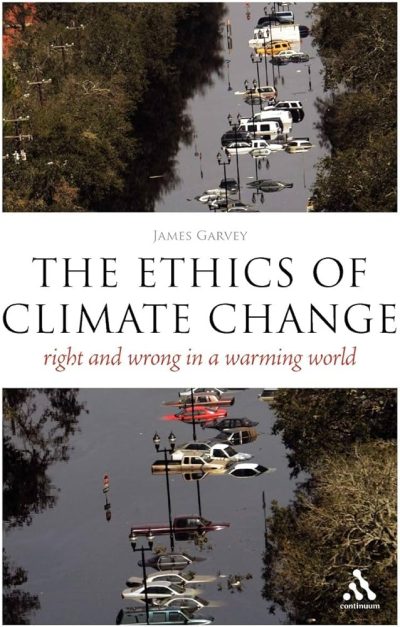
James Garvey’s accessible introduction to the ethics of climate change was one of the earliest single-authored books on the topic in English and is well-worth highlighting as a significant climate book from 2008. Garvey (b. 1967) is currently professor of liberal arts at the College for Creative Studies in Detroit and editor-at-large for The Philosophers’ Magazine, a quarterly which aims to publish readable, accessible philosophy. When he published ‘The Ethics of Climate Change’ in 2008, the 41-yr old Garvey was Managing Director of the Royal Institute of Philosophy in the UK and co-editor with Jeremy Stangroom, of ‘Think Now’, a series of books from Continuum on social and political philosophy, a series in which Garvey’s own book appears.
Garvey opens his case by making the obvious, but frequently forgotten, point that while “science can give us a grip on the facts, … we need more than that if we want to act on the basis of those facts. That something more which is needed involves values” [p.2]. Elucidating different human values is exactly what philosophers exist for, a purpose quite different from that of research scientists. This focus on values was at the heart of my own book ‘Why We Disagree About Climate Change’ which was published the following year. After briefly introducing the scientific evidence for climate change and the most relevant arguments from moral philosophy, Garvey enters a discussion about who is responsible for climate change—both for causing it and for doing something about it. These four central chapters are headed ‘Responsibility’, ‘Doing Nothing’, ‘Doing Something’ and Individual Choices’, and he runs through the arguments with respect to governments, states, corporations and individuals in the industrialised world. Twenty years later, with the changing world distribution of power, wealth and emissions, his arguments would land differently I think.
Book-length writings about the ethics of climate change really began to take off after the book appeared. Before Garvey, only Donald Brown’s ‘American Heat: Ethical Problems with the United States’ Response to Global Warming’ (Rowman & Littlefield, 2002) and Clive Spash’s ‘Greenhouse Economics: Values and Ethics’ (Routledge, 2005) existed. After Garvey, another 30 or 40 books on the topic have been published.
McIntosh,A. (2008) Hell and High Water: Climate Change, Hope and the Human Condition. Edinburgh: Birlinn. 289pp.
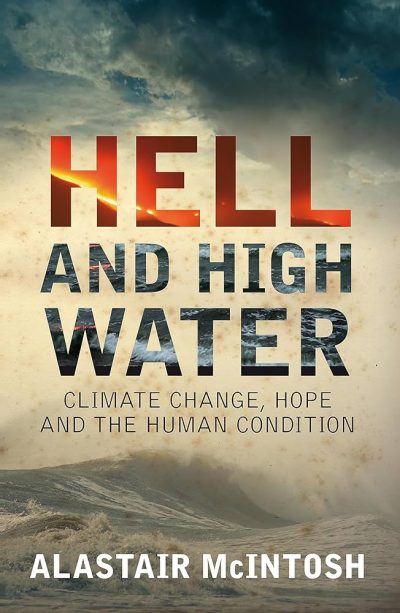
As my series on ‘Climate Books of the Year’ has frequently commented, the first decade of the 21st century began to see the widening of authorial voices writing books about climate change. Making sense of climate change as a human phenomenon, and therefore as a cultural one, required voices being heard from well beyond the disciplines of science, politics and economics (and, in due course, from beyond the western world of the north Atlantic and the Anglosphere). ‘Hell and High Water: Climate Change, Hope and the Human Condition’, published in 2008, indeed brought a different voice and perspective to bear.
The book was written by Scottish Quaker, writer and campaigner Alastair McIntosh (b. 1955). For the past 30 years, McIntosh, originally from the Isle of Lewis in the Outer Hebrides of Scotland, has worked mostly freelance as a writer, researcher and activist, although for a while he was also Scotland’s first professor of human ecology, a position held at the University of Strathclyde. Since 2004, McIntosh has lived in Glasgow where he writes, speaks, and campaigns about spirituality, place, land and community. His earlier book from 2001, ‘Soil and Soul’, had been well received and in ‘Hell and High Water’ he brings these same perspectives to bear on the questions he sees being raised by climate change.
McIntosh writes about the science of climate change, but more importantly he writes about the human condition and what it means to belong in places as the climate changes, to be connected to each other and to the land. McIntosh admits “[this] has been a terribly difficult book to write” since it was “difficult at first to see much hope” in climate change [p.245]. But he uses the resources of Celtic spirituality and of Quakerism to bring spiritual dimensions of hope into his writing and to offer a very different set of pathways for humans to explore in their responses to fear and anxiety triggered by a changing climate.
[1] Butler,D. (2007) Darfur’s climate roots challenged. Nature 447 (June 27): 1038.
[2] Ragnhild,N. and Gleditsch,N.P. (2007) Climate change and conflict. Political Geography. 26: 627-638.
[3] These examples were used as part of my argument in: Hulme,M. (2008) The conquering of climate: discourses of fear and their dissolution. The Geographical Journal. 174(1): 5-16
[4] Goell,E. (2011) Review of ‘Climate Wars: The Fight for Survival as the World Overheats’. Critical Policy Studies. 5(4): 471-473.
[5] O’Neill,S.J. and Nicholson-Cole,S. (2009) ‘Fear won’t do it’: Promoting positive engagement with climate change through imagery and icons. Science Communication. 30(3): 355-379.
[6] Welzer,H. (2008) Klimakriege: Wofur in 21. Jahrhundert Getötet Wird. Frankfurt-am-Main: S Fischer Verlag Gmbh. An English language edition of this book appeared a few years later: Climate Wars: What People Will Be Killed For in the 21st Century (Polity, 2012).
[7] Daoudy,M. (2020) The Origins of the Syrian Conflict: Climate Change and Human Security. Cambridge: Cambridge University Press.