

David Keith, ‘A Case for Climate Engineering’ (Cambridge MA: MIT Press. 194pp.)
1 July 2026. This is roughly an 8 minute read.
This essay continues my series of monthly posts in which I select one ‘climate’ book to highlight and review from one of the 44 years of my professional career in climate research (starting with 1984, my first year of academic employment). The series will end in September 2027, the month in which I shall retire. See here for more information about the rational for this series, and the criteria I have used in selecting my highlighted books.
This ‘2013 essay’ can be download as a pdf.
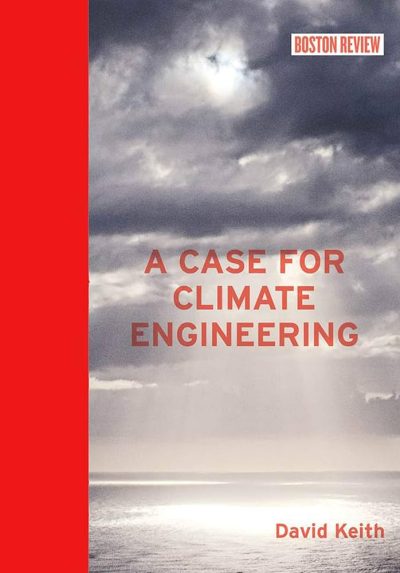
The idea to intentionally alter the climate—sometimes referred to as weather or climate modification or climate- or geoengineering—has a long and checkered history.[1] It has sometimes been accomplished on very small scales, altering microclimates to varying degrees of success, for example through irrigation, painting surfaces white, planting (or removing) trees, and so on. But to do so on a larger, planetary scale is not so easy.
This latter ambition was first outlined seriously in a report delivered to US President Lyndon Johnson in 1965. This wide-ranging document—written by a newly constituted ‘Environmental Pollution Panel’ overseen by the President’s Office for Science and Technology—identified the threat of the rising concentration of atmospheric carbon dioxide as one of a dozen or so large-scale environmental challenges facing America in the 1960s. The nature of this atmospheric threat was outlined in a 20-page Appendix, which also proposed possible geoengineering interventions that might offset the undesirable warming effect of carbon dioxide. “The possibilities of deliberately bringing about counter-veiling climatic changes therefore need to be thoroughly explored,” the report stated. Changing the planet’s albedo—its reflectivity—was considered feasible in principle, either “by spreading very small reflecting particles over large oceanic areas”, or else by injecting condensation or freezing nuclei into the atmosphere “to cause cirrus clouds to form at high altitudes”.[2]
Over the next few decades scientific attention was occasionally given to these, and related, ideas but serious propositions were limited by the rudimentary knowledge of how the climate system worked. Yet it was clear, in principle, that it should be feasible to counter the theoretical warming effect of carbon dioxide by mimicking the cooling effect of volcanic eruptions, industrial aerosol pollutants or biogenic dust particles. Whether the warming effect of carbon dioxide and/or the cooling effect of aerosols were already altering the global climate was the question that fuelled the public climate debates of the 1970s.
The eruption of Mt. Pinatubo in the Philippines in June 1991 led to a temporary global cooling of around 0.5°C. This triggered another round of discussions about the idea of deliberately modifying the global climate through injecting particles into the atmosphere. And, so, in 1994, the annual meeting of the American Association for the Advancement of Science hosted a symposium on the topic which resulted, a couple of years later, in a special issue of the journal Climatic Change. This was commissioned by its editor, Steve Schneider and in that issue environmental scientist Gregg Marland asked the question, “Could we/should we engineer the Earth’s climate?” No clear answer was offered.[3]
Ten years later, in 2006, Schneider repeated the exercise in his journal. One of the essays—written by the Nobel Prize-winning atmospheric chemist Paul Crutzen—was to prove catalytic. Crutzen pointed to the limited success thus far in reducing global emissions of greenhouse gases. In fact, the opposite was happening due largely to China’s rapid economic growth. Crutzen therefore proposed that “the usefulness of artificially enhancing Earth’s albedo and thereby cooling climate by adding sunlight reflecting aerosol in the stratosphere might again be explored and debated as a way to defuse the Catch-22 situation.”[4]
Within three years of Crutzen’s article appearing—its effect was later referred to as “lifting the taboo” on solar climate engineering[5]—the Royal Society of the UK had published a heavyweight report ‘Geoengineering the Climate: Science, Governance and Uncertainty’, and the US National Academy of Sciences followed suit a few years later. The first full-length books on geoengineering began to appear around the year 2010, not least Jim Fleming’s historical survey of previous attempts, many of them futile, to deliberately alter the climate.[6]
By 2013, the scientific and political case for embarking on research into solar climate engineering was being made more loudly and I have therefore selected as my 2013 Climate Book of the Year David Keith’s ‘A Case For Climate Engineering.’ British-Canadian physicist David Keith (b. 1963) was at the time a 50-year-old professor of applied physics and public policy at the Kennedy School at Harvard University where later, in 2017, with climate economist Gernot Wagner he co-founded Harvard’s Solar Geoengineering Research Program.
For much of his early career, Keith’s geoengineering research had focused on carbon sequestration and direct air capture of carbon dioxide. But in 2008, just two years after Cruzen’s “breaking the taboo” article, he teamed up with Canadian political scientist, Thomas Homer-Dixon, to write an opinion essay for the New York Times, ‘Blocking the Sky to Save the Earth’. This intervention called for a properly funded government programme of research to “figure out what [climate] engineering approaches might work … While we should all hope that we never need to play God with the earth’s climate, we must also have the best science at hand to do what might be necessary if melting polar ice leads to a far more dangerous future.” Thereafter, Ketih began writing high-profile essays in scientific journals advocating for research into the technology, for example in 2010 arguing that “…the risks of not doing research [into solar radiation management] outweigh the risks of doing it.”[7]
Keith’s book, ‘A Case for Climate Engineering’, was the culmination of his advocacy over previous years. It offered a systematic outline and defence of his position on deliberate large-scale intervention in the global atmosphere. His conviction was clear: “Assuming geoengineering works as well as the early science suggests that it does, then it is hard to avoid the conclusion that some geoengineering should be implemented.” [p.168] ‘A Case for Climate Engineering’ was published as an MIT Boston Review Book, a publishing series with the laudable strapline “democracy depends on public discussion.” In keeping with this mission, the book advanced a passionate argument in favour of climate engineering research. In the spirit of promoting public discussion, Keith left his readers with a challenge: “I have concluded that it makes sense to move with deliberate haste towards deployment of geoengineering. You may well reach a different conclusion. My goal is to simply convince you that’s it’s a hard choice.” [p.xii]
By then, I had indeed reached ‘a different conclusion’. A few months before Keith’s book was published, I had been approached by Polity Press in the UK to write a short book about climate change in their New Human Frontiers series. The precise topic was left open and although at the time I was unaware of his forthcoming book, I decided to tackle the same question that Keith would address: ‘Should research on climate engineering be promoted?’ My answer to the question was ‘no’.
I wrote my book over the summer of 2013, and the manuscript was already with the publisher when Keith’s ‘A Case for Climate Engineering’ was published in September. It was too late to change my title, ‘Can Science Fix Climate Change’, but as a signal that I was challenging Keith’s arguments I added the subtitle ‘A Case Against Climate Engineering’.[8] The pre-publicity for my book now led us to fulfil the mission of the Boston Review Book series, namely public discussion. In late November, we published a jointly written on-line debate for The Guardian newspaper’s website, Climate science: can geoengineering save the world?, and a few days later, on 2 December, we debated the question in front of a live audience at the Oxford Martin School at Oxford University.
All of this helped generate publicity not just for Keith’s book, but for the important questions about science, technology, risk, justice and ethics that were raised by the idea of deliberate attempts to manipulate the Earth’s climate. Although Keith and I answered these questions differently, we both recognised what was at stake in deciding which path to follow. A review of both books for the journal Global Justice, recognised the value of these competing arguments:
Given the expanding role geoengineering is playing in the discussion of policy responses to climate change, both Hulme’s and Keith’s books are essential for anyone interested in climate ethics and justice. Each book is easily accessible to a broad audience, and it is worth reading them together … to simultaneously weigh the arguments against one another.[9]
Although I took a different position to Keith, his book was well written. The view given by Nick Srnick for the online magazine, ‘Review 31’ was one I agreed with. “‘A Case for Climate Engineering’”, wrote Srnick, “is … a significant intervention: it’s written concisely, it’s humble in its limits, and it clarifies the stakes of the debate. In the end, it is an important call to move beyond the stultifying precautionary principle and to embrace a modern Prometheanism.” This embrace was indeed what Keith was calling for. ‘A Case For Climate Engineering’ achieved considerable exposure, as did Keith himself, both then and later, as a prominent advocate for the technology. The book was reviewed in Nature in October 2013, and a three-page profile of Keith, and his book, was published the same month in Science.[10] This profile article revealed something of Keith’s back-story and personality, his motivations and his scientific and business entrepreneurship.
In the latter, some of his adversaries saw a conflict of interest with his advocacy of government support for research into climate engineering. It is certainly true that undisclosed conflicts of interest plagued some of the early attempts at real-world experimentation of the technology. Yet Keith was very open about this and he devoted two pages of his Preface to a section titled ‘A final note about money and conflict of interest.’ [p.xxii-xxiii] He was also aware of being part of what science journalist Eli Kintisch, in his own book on geoengineering, had previously labelled “the geoclique”, a small group of mostly mid- or late-career white, male scientists in North America and Europe who were promoting the technology.[11] Kintisch’s observation was certainly true in 2013, although perhaps a little less so today.
Over the subsequent 20 years, David Keith became one of the most recognised voices advocating for a substantial, publicly funded research programme into the climate intervention technology of stratospheric aerosol injection. In 2023, he moved from Harvard to the University of Chicago where he founded the Climate Systems Engineering Initiative to further this goal. His public advocacy continues, and he has not deviated far from the arguments advanced in his 2013 book. Thus, in August 2024, the New York Times ran a feature article about him and his vision under the headline, ‘Buying time. This Scientist Has a Risky Plan to Cool Earth. There’s Growing Interest’. The journalist, David Gelles, described his vision thus: “David Keith wants to spray a pollutant into the sky to block some sunlight. He says the benefits would outweigh the danger.”
I continue to disagree.
© Mike Hulme, July 2026
Subscribe to our newsletter!
Other significant books published in 2013
McKenzie Funk, ‘Windfall: The Booming Business of Global Warming’ (New York: Penguin Press. 320pp.)
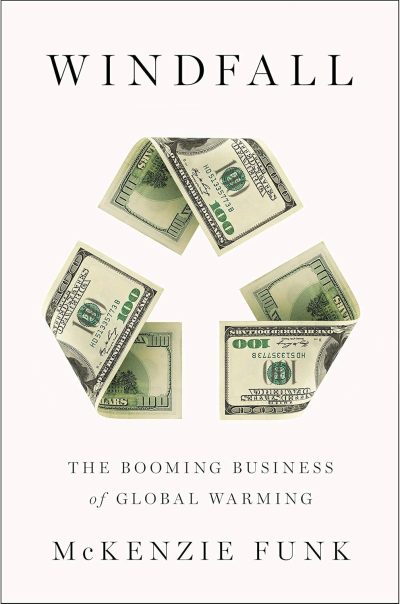
A change in the climate is not universally a bad thing for everyone on the planet. This observation was the starting point for McKenzie Funk’s exploration of how people around the world were preparing for a warmer planet, people who saw market opportunities in the changes wrought by a change in the climate. ‘Windfall: The Booming Business of Global Warming’ was written by the prolific American journalist McKenzie Funk and offered a thoroughly researched examination of some of both the mundane and exotic upsides of climate change.
Over a six-year period, Funk seemed to have travelled almost everywhere on the planet: to Canada’s Northwest Passage, Greenland, the European Alps, Australia, the north, south, east and west of the USA, South Sudan, Senegal, India, Bangladesh, and the Netherlands. Funk’s globe-trotting journalism told a very different tale from that narrated a decade earlier in Mark Lynas’ 2004 ‘High Tide’, which I reviewed in this series. Rather than exposing people’s vulnerabilities to the impacts of climate change, as Lynas did, Funk reported on how these same impacts—melting ice, drought, rising seas, superstorms—became a windfall for ‘climate capitalists’. It turned out, for example, that Russians were taking their lead from their President, Vladimir Putin, who saw that the warming of Russia meant that “we shall save on fur coats,” while Israeli science and technology was very useful for artificial snowmaking in the Alps.[12] And Funk visited Greenland “…to witness the moment that some of the supposed victims of climate change began cashing in on it. Greenland’s was an extreme case of the dilemma facing many citizens of the developed world, many northerners: If climate change wouldn’t much hurt them personally—if it might even help—why not embrace it?” [pp.61-62] What was bad news for flood-stricken Bangladeshis, turned into good news for Greenland’s separatists, hoping to break free of Denmark and profit from an Arctic mineral boom. (Thirteen years later, of course, this isn’t quite how things have worked out for Greenlanders, but one shouldn’t reprimand Funk for this forgivable lack of foresight).
A short review of the book in Nature, from January 2014, summarised the book well: “This exposé of the powers and people that view global warming as an investment opportunity is darkly humorous and brilliantly researched.”
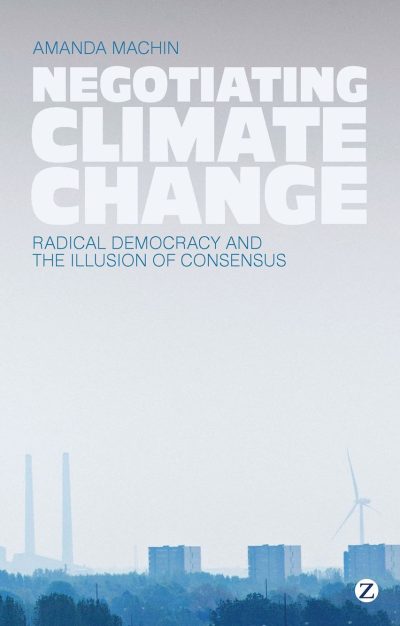
Amanda Machin, ‘Negotiating Climate Change: Radical Democracy and the Illusion of Consensus’ (London: Zed Books. 170pp.)
It is often said that the art of politics is not to get everyone to agree with you, but rather to find some limited common cause with those with whom you disagree in order to design and enact pragmatic policies that have a chance of succeeding. While this might be the hallmark of a successful politician operating within a democracy, it is not how a lot of climate advocacy had been pursued. Too often, activists had used science as a lever to force consensus—‘the science says we must.’ Much effort had been expended in trying to get everyone to agree about climate change—about its causes, risks and responses—but then get frustrated, angry or disillusioned when this tactic failed.
In ‘Negotiating Climate Change: Radical Democracy and the Illusion of Consensus’, political scientist Amanda Machin outlined a different approach for citizens living in democratic states. She drew on the work of radical democrats Jacques Rancière, Slavoj Zizek and Chantal Mouffe to argue that an ‘agonistic politics’ around climate change—negotiating over disagreements—was likely to defuse antagonistic, more conflictual, sometimes violent reactions. Given that consensus on how to combat climate change will never be reached, there could never be one ‘rational’ path, no overarching grand strategy, that suited everyone. Better to acknowledge this from the start and realise that people with whom you disagree are not necessarily misguided, malicious or out to harm you.
Machin showed that such disagreement did not necessarily have to hinder collective action; rather, negotiating between different positions was necessary to maintain some hope of acting collectively against climate change. This is what Machin termed “radical democracy” and which, in her view, stood a better chance than other approaches of mustering meaningful and enduring policies to address climate change. In her own words, “By noticing the disagreements spawned by [a] changing climate in a changing world, we may be able to negotiate decisions without waiting for an illusionary consensus.” [p.130].
I endorsed Machin’s book at the time of publication, offering this assertion: “… asking science to forge a consensus that will drive decisive political action misunderstands climate, science and politics in equal measure. Be warned: if you are sure about how climate change can be solved, and why it’s not being, then this book is not for you.”
[1] Fleming, J.R. (2010) Fixing the Sky: The Checkered History of Weather and Climate Control. New York: Columbia University Press.
[2] See Appendix Y4 ‘Atmospheric carbon dioxide’ in: President’s Science Advisory Committee (1965) Restoring the Quality of our Environment. Report of the Environmental Pollution Panel. (November). Washington DC.
[3] Marland, G. (1996) Could we/should we engineer the Earth’s climate? Climatic Change. 33: 275–78.
[4] p.213 in: Crutzen, P.J. (2006) Albedo enhancement by stratospheric sulfur injections: a contribution to resolve a policy dilemma. Climatic Change. 77(3/4): 211-20.
[5] Lawrence, M.G., and Crutzen, P.J. (2017) Was breaking the taboo on research on climate engineering via albedo modification a moral hazard, or a moral imperative? Earth’s Future, 5(2): 136-143.
[6] Fleming, op. cit.
[7] Keith, D.W., Parson, E. and Granger-Morgan, M. (2010) Research on global sun block needed now. Nature. 463: 426-27.
[8] Hulme, M. (2014) Can Science Fix Climate Change? A Case Against Climate Engineering. Cambridge: Polity.
[9] Callies, D.E. (2015) ‘Climate Engineering: For and Against’ Global Justice 8(2): 104-10.
[10] Jones, N. (2013) One cool solution. Nature. 502 (17 October): 302. Kintisch,E. (2013) Dr. Cool. Science. 342 (18 October): 307-09.
[11] Kintisch, E. (2010) Hack The Planet. Science?s Best Hope–or Worst Nightmare–for Averting Climate Catastrophe. Hoboken, NJ: John Wiley and Sons.
[12] Broughton, P.D. (2014) Book Review: ‘Windfall’ by McKenzie Funk. Wall Street Journal, 28 January.