
Katharine K Wilkinson, ’Between God and Green: How Evangelicals are Cultivating a Middle Ground on Climate Change’ (New York: Oxford University Press. 256pp.)
1 June 2026. This is roughly an 8 minute read.
This essay continues my series of monthly posts in which I select one ‘climate’ book to highlight and review from one of the 44 years of my professional career in climate research (starting with 1984, my first year of academic employment). The series will end in September 2027, the month in which I shall retire. See here for more information about the rational for this series, and the criteria I have used in selecting my highlighted books.
This ‘2012 essay’ can be download as a pdf.
In February 2006, full-page announcements in the pages of the New York Times and Christianity Today, American evangelicalism’s flagship magazine founded by Billy Graham in 1956, introduced Americans to a surprising new climate change initiative. These adverts contained the coming-out statement of the ‘Evangelical Climate Initiative’ (ECI), a Christian network newly formed by senior American evangelical leaders. Among the 86 prominent signatories were the presidents of 39 evangelical colleges, leaders of Christian aid groups such as the Salvation Army, and pastors of megachurches, including Rick Warren, author of the 2002 US best-seller ‘The Purpose-Driven Life’. The announcement was clear about the network’s aims and motivation: “Our commitment to Jesus Christ compels us to solve the global warming crisis.”
Launching the ECI on Wednesday 8 February at the National Press Club in Washington DC, Rik Warren, Richard Cizik—vice-president of the National Association of Evangelicals representing 45,000 churches in the US—and their colleagues outlined a new position for American evangelicals. “For most of us, until recently this has not been treated as a pressing issue or major priority,” the statement said. “Indeed, many of us have required considerable convincing before becoming persuaded that climate change is a real problem and that it ought to matter to us as Christians. But now we have seen and heard enough.”
The 2006 launch of the ECI generated intense media coverage in the United States. Students and scholars, as well as journalists, were intrigued about its potential to transform the American climate debate, an intrigue heightened by the timing of its public announcement. This was the same year as Al Gore’s award-winning documentary ‘An Inconvenient Truth’, shortly before the publication of the IPCC’s Fourth Assessment Report, and during a period (through 2008) when prominent Republican politicians such as John McCain and Newt Gingrich were supportive of climate legislation. The ECI’s creation was well timed to give a critical boost to the campaign for major climate legislation in the USA.
Reading the NY Times that February morning was a 23-year-old American working for the environmental non-profit National Resources Defence Council (NRDC). Katharine Wilkinson was recently out of college and the recipient of a Rhodes Scholarship which would enable her later in 2006 to commence PhD studies at Oxford University. Wilkinson was struck by the boldness of the ECI’s announcement coming as it did from an unlikely section of the American church. Most senior evangelical leaders in the USA were staunch supporters of the Republican Party and approved of President George W Bush’s opposition to taking climate change seriously as a matter either for public policy or individual action.
Although the NRDC was based in New York, Wilkinson was spending most of her time in Tennessee, interfacing with rural county mayors, landowners, the governor’s office and the state department of the environment in Nashville. Speaking to me much later, she remembered how she felt at the time: “A lot of ‘big green’ environmentalism was speaking right past much of America”, she said, “even when folks cared about land, about place. I wondered if there might be other fruitful approaches that could bridge [that gap] rather than bypass it”.[1]
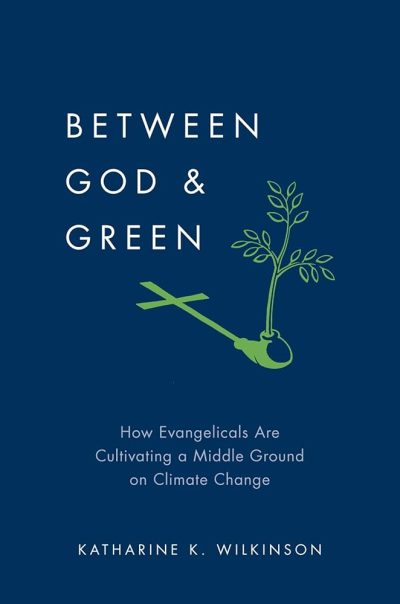
It was at this moment that Wilkinson read about the Evangelical Climate Initiative in the Times. It was to lead to her to dig deep into its origins, ethos and reception for her PhD which she completed at Oxford between 2006 and 2010. Her thesis was published two years later as ‘Between God and Green: How Evangelicals are Cultivating a Middle Ground on Climate Change’ and I have selected this as my 2012 Climate Book of the Year. Katharine Wilkinson (b.1982) is an American writer, educator and climate change activist, and co-founder of The All We Can Save Project, a climate leadership organization. Before her year with the NRDC, she had gained her bachelor’s degree in religious studies from Sewanee: The University of the South, a private liberal arts college of the Episcopal Church of America.

I should declare that I was the external examiner for Wilkinson’s Oxford PhD thesis, which formed the basis for ‘Between God and Green’. My examiner’s report from April 2010 summarised her thesis as an original empirical investigation into the ways in which American evangelical Christians had engaged with the idea of anthropogenic climate change over the years leading up to 2008. My summary report also noted that her thesis showed how the issue of climate change was being used within American evangelicalism “to renew and refresh the movement’s involvement with environmental and social justice concerns”. I concluded by saying that her study “reveals the tensions between leadership and grass-roots positioning on climate change in relation to personal and political action.”
‘Between God and Green’ used extensive interviews with evangelical leaders and a series of focus groups undertaken with church members, as well as analysis of textual material. Wilkinson used these empirical data to explore the phenomenon of what she called “climate care”. This included its historical roots and theological grounding, as well as its visionary leaders and advocacy initiatives. The book outlined the ECI’s “Call to Action”, which unfolded in four declarative steps: (i) human-induced climate change is real; (ii) the consequences of climate change will be significant, and will hit the poor the hardest; (iii) Christian moral convictions demand a response to the climate change problem; (iv) the need to act now is urgent. Governments, businesses, churches, and individuals all have a role to play in addressing climate change—starting now.
The ECI’s ‘call to action’ outlined a clear leadership stance which favoured constructive engagement with public policy and social action. Yet Wilkinson was guarded in the conclusions she drew from this—lay church members may see things very differently from their leaders. ‘Climate care’ faced difficulties, she wrote, “because it attempts to resonate with lay evangelicals’ existing values and beliefs whilst simultaneously trying to change them” [p.109]. Wilkinson also contrasted this reading of Christian ethics with that offered by other, more sceptical, Christian organisations such as the Cornwall Alliance and the Southern Baptist Convention. The book’s appendices included a useful set of public positional declarations and statements on ‘climate care’ issued by various evangelical bodies between 1994 and 2009, including one that I signed in 2002, ‘The Oxford Declaration on Global Warming’.
‘Between God and Green’ sold quite well as an academic book, especially in the United States, and Wilkinson toured the country speaking about it at universities and book festivals. This sometimes led to amusing misunderstandings. Speaking at the University of Mississippi, aka Ole Miss, and strongly Republican, Wilkinson remembered that just as her lecture was beginning “dozens of very clean-cut young guys in khakis walked in. I thought for sure it was the Young Republicans, who’d come to take me down”. These men turned out to be a pledge class of a fraternity on campus and they had been either required or cajoled to attend her lecture. “Presumably,” remembered Wilkinson, “they had slightly misunderstood the religious angle of the book and thought it would be more like a bible study.”[2]
Her book made the news pages of several American outlets in 2012, such as The Washington Times and The Boston Globe. Climate activist/journalist Wen Stephenson reviewed it for The Globe, calling it “a vitally important, even subversive, story.” It was also widely reviewed in a range of religious and social science journals, such as Environmental Values, the Journal of Religion, the Journal of the American Academy of Religion,and Sociology of Religion.
Reviewing for the Journal for the Scientific Study of Religion, Stephen Ellingson summarised ‘Between God and Green’ as “an intriguing inside look at an attempt to turn evangelicalism green, the stiff resistance it has met, and how that resistance is bound up with evangelicals’ commitments to secular ideologies and political agendas” and the veteran American environmental lawyer and advocate Gus Speth blurbed the book approvingly: “’Between God & Green’ is a great story, one where faith breaks free of conventional boundaries and expectations and expresses itself in a profound way on one of the great moral and political challenges of our time, the human threat to the stability of the planet’s climate.”[3] Yet other reviewers drew attention to the limitations that Wilkinson herself had noted in the book. Robin Veldman’s review, for example, identified Wilkinson as “one of just a few voices who are beginning to conclude that religions may be a bit overrated when it comes to their potential to spur a response to the climate crisis.”[4]
Wilkinson’s book brilliantly captured a period in the mid-to-late 2000s when new configurations and alignments of political interests in the United States seemed possible. ‘Between God and Green’ offered a unique insight into the internal politics of American evangelicalism and of the different ways in which Christian theology, faith, practice and social action could be brought to bear on the issues raised by climate change. It was valuable for showing how different meanings and interpretations of science and theology can lead to taking very different positions on the reality, challenges and responses to a changing climate. I believe Wilkinson’s was the first empirical book-length study of how a specific Christian tradition, in this case US evangelicals, was reacting to climate change. It would be a path that several others would later follow, for example Peter Thuesen’s ‘Tornado God: American Religion and Violent Weather’ (OUP, 2020), and Tom Albrecht and Tom Sturm’s ‘Apocalyptic Conspiracism: American Evangelicalism in an Age of Climate Crisis’ (Bloomsbury, 2025).
Wilkinson concluded ‘Between God and Green’ optimistically: “Climate care leaders … are dedicated to shaping American evangelicalism into the kind of faith community that would enshrine the case of creation and its humanity community as essential concerns” [p.140]. This dedication that Wilkinson praised is undoubtedly true of some church leaders, but her optimism has not worn well for reasons revealed by her own analysis of the attempt to turn evangelicalism green. The political headwinds of the past two decades have limited the wider impact of the ECI on climate politics in the US, even while other activist evangelicals have emerged with a prominent public voice, for example climate scientist Katherine Hayhoe, currently Chief Scientist at the Nature Conservancy.[5] The Republican Tea Party, founded in 2009, promoted a more aggressive climate scepticism among Republicans—the voting destination of some 80 percent of American evangelicals—a scepticism that Trump’s MAGA movement has promoted further in recent years.[6]
But none of this diminishes Wilkinson’s original motivation for conducting her study reported in ‘Between God and Green’, namely to find better ways to engender social action on climate change among American citizens. Recognising this, and her later advocacy work, in 2019 Time magazine named Wilkinson, alongside leading influencers such as Christiana Figueres, Sunita Narain, and Greta Thunberg, as one of their fifteen “women leading the fight against climate change.”
© Mike Hulme, June 2026
Subscribe to our newsletter!
Other significant books published in 2012
Dieter Helm, ‘The Carbon Crunch: How We’re Getting Climate Change Wrong – And How To Fix It’ (1st Edn.) (New Haven, CT: Yale University Press. 273pp.)
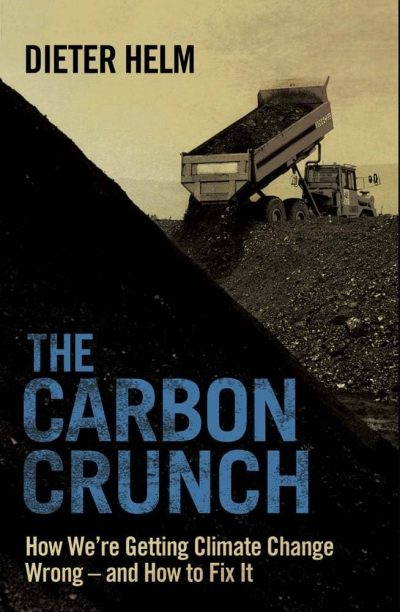
By 2012, global carbon emissions had grown year on year ever since the UN Framework Convention on Climate Change was signed in 1992, apart from a one-year dip in 2009 following the Global Financial Crisis. This trend showed either that the momentum behind the growth of the global carbon economy was unstoppable by policy interventions, or else that the policies and measures that had been pursued by the international community were the wrong ones. In 2012, the British energy economist Dieter Helm published ‘The Carbon Crunch: How We’re Getting Climate Change Wrong – And How To Fix It’, his attempt to explain this policy failure. Helm wrote in non-technical language, with clarity and vivacity, and laid out the problem in stark terms: “Despite a multitude of summits, speeches and commitments, and a host of energy policies, emissions keep going up. Not even a world recession has made much difference.” [p.ix]
As Professor of Economic Policy at Oxford University, Helm (b.1956) was, and still is, a significant voice in UK and international policy debates. By 2012 he had already served on numerous UK Government task forces and panels: the Ministerial Task Force on Sustainable Development, the Sustainable Energy Policy Advisory Board, the Energy Advisory Panel of the Department of Trade and Industry, the Economics Advisory Group to the Secretary of State for Energy and Climate Change. His views should not be dismissed lightly. ‘The Carbon Crunch’ was clear-eyed about the scale of the climate challenge and his analysis of what had gone wrong spared no one. One reviewer of the book wrote that his criticism
…of individuals and groups, [extends] from Lord Nicholas Stern and Jose Manuel Barroso, to Greenpeace and the financial whizz-kids from McKinsey. Helm is merciless in laying out the mendacity of politicians, the ruthless self-interest of business lobbies, and the (perceived) hypocrisy and wrong-headedness of campaigning NGOs.
Helm pricked the bubble of the naïve green lobby who didn’t want to face the real challenges of decarbonising the world. “It is hard to find any mainstream climate change scientist or economist,” wrote Helm, “who now believes that global warming can be limited to 2°C.” [p.ix]
While criticism is easy, Helm was equally clear about the fixes to energy policy that were necessary. Rather than the top-down internationally imposed targets and timetables of the discredited Kyoto Protocol, he argued for a bottom-up approach. Helm’s fix was to hasten the switch to gas through a carbon price—thereby displacing coal which was the real enemy—and then wait for investments in the next generation of renewables to pay off. Investing in new nuclear would yield benefits on an intermediate timescale. Given Helm’s merciless critique of existing policies, his solutions might have lacked detail and political realism. Nevertheless, ‘The Carbon Crunch’ was a provocative, hard-hitting and necessary analysis. Its success led to a new and fully revised edition of the book in 2015 and over the subsequent decade Helm has continued to point out to anyone who will listen the deficiencies in the existing approach to energy policy and the international climate treaty process.
Barbara Kingsolver, ‘Flight Behaviour: A Novel’ (London: Faber & Faber)

Through the medium of storytelling, novels can negotiate between competing cultural values, conveying contrary experiences of class, race, and gender. They also can provoke reflection about our actions in the world in relation to the subjectivities of others and about the imagined possibilities of an unknown future. Literature therefore plays an important public role in illuminating the idea of climate change. By the early 2010s, there was a growing literary engagement with the idea of climate change. The abbreviation ‘cli-fi’ had been coined by the journalist Dan Bloom in 2011 and novelists were increasingly experimenting with the literary genres of realism, magical realism, speculative fiction, and Romanticism to try and capture the complexity and ambiguity of climate change.
Given its scale, scope and complexity in space and time, the idea of climate change presented a particular difficulty to realist novelists. Nevertheless, some well-known authors enrolled in the project of producing realist Cli-Fi and around the years 2010 to 2012 a clutch of novels in this genre were published, including ‘Flight Behaviour’ by Barabara Kingsolver. Kingsolver (b.1955) is a Pulitzer Prize-winning American novelist, essayist and poet, and ‘Flight Behavior’ was her seventh novel and, like her previous ones, became a New York Times bestseller. ‘Flight Behavior’ told the story of how a young farmer’s wife, Dellarobia Turnbow, on a poor family farm in America’s depressed Bible Belt and trapped in an unhappy marriage, learned the truth about climate change and its consequences. She came to understand that millions of displaced monarch butterflies were a symptom of climate change and in the process of this enlightenment gained her independence.
The book explored the economic, social and cultural reasons for the prevalence of climate scepticism in America’s southern states and was generally well-received by literary critics. It captured well the social realities of small-town rural America and its climate scepticism. As two critics wrote a few years later about her novel, “Kingsolver does the good work of literary realism, complicating the stereotypical certainty of scientists, and the ignorance of rural southerners, as well as [questioning] the effectiveness of interventions by well-meaning activists”.[7] On the other hand, as noted by another reviewer, Kingsolver’s frequent insertions of instructive text about climate science was laboured—a point also noted in Ian McEwan’s realist Cli-Fi novel ‘Solar’ from 2010—and left the reader too often feeling they were in the classroom or else conveyed the “whiff of the pulpit.”
[1] Katharine Wilkinson, pers. comm., 4 February 2026.
[2] Katharine Wilkinson, pers. comm., 4 February 2026.
[3] Ellingson, S. (2012) ‘Between God and Green.’ Journal for the Scientific Study of Religion. 51(4): 824-25.
[4] Veldman, R.G. (2013) ‘Between God and Green’. Journal of the Study of Religion, Nature and Culture. 7(3): 360-62.
[5] Hayhoe, K. (2019) ‘I’m a Climate Scientist Who Believes in God. Hear Me Out’ New York Times, 31 October.
[6] Veldman, R.G. (2019) The Gospel of Climate Skepticism: Why Evangelical Christians Oppose Action on Climate Change. University of California Press.
[7] p.239 in: Goodbody, A. and Johns-Putra, A. (2019) ‘The Rise of the Climate Change Novel.’ Chapter 19 in: Climate and Literature (ed.) Johns-Putra, A. Cambridge: Cambridge University Press.