
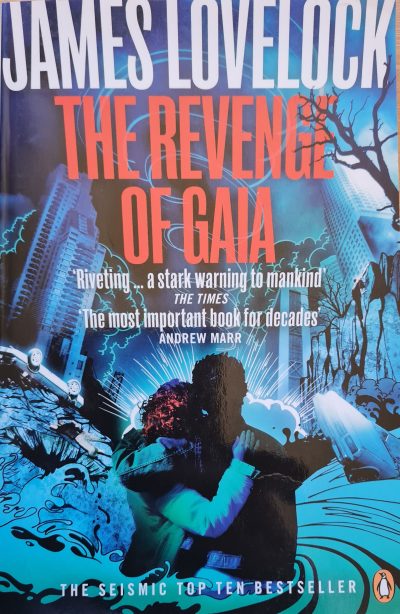
Lovelock,J. (2006) The Revenge of Gaia: Why the Earth is Fighting Back – And How We Can Still Save Humanity. London: Penguin. 222pp.
This essay continues my series of monthly posts in which I select one ‘climate’ book to highlight and review from one of the 44 years of my professional career in climate research (starting with 1984, my first year of academic employment). The series will end in September 2027, the month in which I shall retire. See here for more information about the rational for this series, and the criteria I have used in selecting my highlighted books.
This ‘2006 essay’ can be download as a pdf.
James Lovelock (1919-2022) was a British scientist, inventor, consultant, futurist, and public intellectual. Above all, Lovelock was an iconoclast, whose free-thinking often led him in unpredictable directions, the more so the older he got. One of his protegees, Tim Lenton, described him this way in 2014, “[he] makes intuitive leaps between topics that most of us would not think to connect … the leaps are so great that at times even [he] seems unsure where his argument is going”.[1] Lovelock’s scientific achievements were recognized in 1974 when he elected a Fellow of the Royal Society and he was garlanded with numerous other awards, prizes and honourable and recognitions—including a CBE in 1990 and a Companion of Honour in 2003 for services to global environmental science.
Among the wider public, however, Lovelock was undoubtedly best known for his Gaia Hypothesis—he later renamed it Gaia Theory—developed jointly in the 1970s with American biologist Lynn Margulis (1938-2011). But as Jonathan Watts’ makes clear in his authorized biography of Lovelock, there is much more to his thought, work, career and achievements than the invention of Gaia.[2] Nevertheless, any account of how climate change has been written about over the past half-century—which is what this series of retrospective book reviews is offering—must consider the writing of Lovelock. Thus I have selected ‘The Revenge of Gaia: Why the Earth is Fighting Back – And How We Can Still Save Humanity’ [hereafter, ‘Revenge’] as my 2006 Climate Book of the Year.
Lovelock was already 86 years old when he published ‘Revenge’. This is evidence of not just an irrepressible, questioning and fiercely independent mind, but also of a robust physical constitution which sustained him for a further 16 years until his death in 2022. ‘Revenge’ was only the latest in a series of books which, after the 1970s, had turned Lovelock from a scientist, consultant and government agent, known to relatively few, into a public intellectual with strong name recognition. This transition had begun with his notion that Earth should be understood as a single interconnected self-regulating physiological organism which has kept the planet fit for life—from algae to humans—for more than three billion years. It was an idea for which he adopted, in the early 1970s, the mythical name, Gaia—proposed by his near neighbour, the novelist William Golding.[3] Lovelock popularized this idea in 1979 in his first major book, ‘Gaia: A New Look At Life on Earth’, to be followed by several more in the subsequent 27 years.[4]
By 2006, Lovelock was an iconic figure for proponents of many different strands of environmental science, philosophy and activism. But his position outlined in ‘Revenge’ disturbed and confused many, myself included. I never met Lovelock, but I bought his 1979 book, ‘Gaia’, while I was an undergraduate geography student and purchased my own copy of ‘Revenge’ in October 2007, which I cited widely in my 2009 book, Why We Disagree About Climate Change’. I commented that his introduction of the metaphor of Gaia “has had a profound influence on some of the ways in which science and society have come to view climate and to speak about it” and I drew attention to the pessimism which pervaded Lovelock’s view of the future of humanity based on his belief in our erosion of Gaia’s self-regulating mechanisms.[5]
As implied by Lenton’s quote above, it is very difficult to contain Lovelock’s thinking within neat, tidy, orthodox and fully consistent boundaries. He was always willing to look at problems in contrary ways, questioning conventional assumptions, whether those of fellow scientists or of campaigning environmentalists. This iconoclastic mind is why for much of his career Lovelock was sought after by many people in science, government and industry on both sides of the Atlantic; it is why Watts adopted ‘The Many Lives of …’ as the title for his biography of Lovelock; and it is why I cannot begin to do justice in this short review to the breadth and complex creativity of his thinking and achievements.
But re-reading ‘Revenge’ after many years, and after recently reading Watts’ biography, I think there are three aspects of the book which are important to foreground in relation to Lovelock’s influence on climate change research, discourse and policy. ‘Revenge’ needs to be interpreted not just in the context of Lovelock’s view of Gaia, but also in relation to the particular moment in which it was written: the mid-2000s. Climate change discourse and campaigning in this decade was a heady mix of both pessimism and optimism about the climatic future, framed by the American withdrawal in 2001 from the Kyoto Protocol and the hopeful anticipation of a more comprehensive climate treaty to be negotiated in the 2009 Copenhagen Conference.
The first of these aspects is the despair which pervades Lovelock’s writing. His sense of doom is inescapable and starts on p.1: “We are now so abusing the Earth that it may rise and move back to the hot state it was in 55 million years ago, and if it does most of us, and our descendants, will die.” And the doom is unrelenting. His probable scenario was that as carbon dioxide concentration passes 500ppm—it is currently around 425ppm—we will “enter a new steady state, perhaps six to eight degrees hotter than now.” [p.82]. And as Lovelock draws the book to a close, he offers that “… we may be unable to prevent a global decline into a chaotic world ruled by brutal war lords on a devastated Earth.” [p.198].
Contemporary reviewers could not escape this dark framing, Martin Lewis writing for the American journal Issues in Science and Technology summarised Lovelock’s views thus: “Gaia’s self-regulatory properties … are about to be overwhelmed by the greenhouse gases spewed out by human activities … The late 21st century, in this grim vision, will be marked by such heat and drought as to reduce most of the world to arid waste”[6], while Camilla Toulmin writing for the UK’s openDemocracy web-site offered: “Iconoclastic and idiosyncratic, [Lovelock] argues that all human civilization is in imminent danger. The language is apocalyptic, even violent. He makes frequent reference to war, the need for defence against the coming attack, proposes the rationing of goods and fuel, and urgent plans made to ward off the chaos ahead.”[7] Even his ardent supporters despaired of Lovelock’s despair. Chris Rapley, the director of London’s Science Museum and one of Lovelock’s confidants, cautioned: “I fear he’s overdrawing our despair budget.”[8]
The second crucial element of ‘Revenge’ was that Lovelock’s conviction of impending environmental and societal collapse led him into a vigorous defence of nuclear energy. The book’s sub-title was “how we can still save humanity” and for Lovelock this salvation was going to entail a massive expansion in nuclear energy: “I see it as the only effective medicine we have now.” [p.14]. Most environmentalists had been adamantly opposed to nuclear energy since the 1970s or 1980s, and many of Lovelock’s supporters in the environmental movement now rebuked him for the ardour with which he now advocated the merits of nuclear power. Martin Lewis’s review captured this aspect of Lovelock’s contrarianism: “[He] was not the first environmentalist to advocate green Prometheanism, but his predecessors have largely been either ignored or reviled as giddy apologists of a cancerous industrial system.”[9] (From the perspective of 2025 it is interesting to note how many environmental campaigners and some NGOs have now reached a similar conclusion to Lovelock with regards to nuclear energy).
There is no doubt that ‘Revenge’ attracted widespread public attention. But among the huge number of reviews it garnered, much less commented on than his pessimism and his advocacy of nuclear power was the third thing that struck me on re-reading the book. This was Lovelock’s search for a religious ethic to guide humanity into the future with Gaia. As with much of Lovelock’s thinking his approach to religious thought was unorthodox and, to some degree, contradictory. In Lovelock’s secular religion, trust is to be placed in Gaia rather than in God, in a scientific book of knowledge—“a new holy book”—rather than in the Bible. In a bizarre analogy he argues that “we need to accept and believe in [this book] at least as much as we did, and perhaps still do, [in] the World Service of the BBC.” [p.203]. Lovelock valorises religion and its civilizing impulses in the past, only to supplant it with a new godless faith, making “Gaia an instinctive belief by exposing our children to the natural world.” [p.175].
There is no doubt that Lovelock’s argument in ‘The Revenge of Gaia’ was painted in bright, bold, primary colours. He recognized many of the dimensions of the complex problem of climate change and simplified them through making big and often startling claims: Gaia’s self-regulation is broken; the future for the human species is gloomy; sustainable development is so much blah-blah; wind and solar energy as a replacement for fossil fuels is a pipe-dream; only the embrace of techno-fixes such as nuclear energy will suffice; people are a plague and there are too many of them on the planet; a new Gaia-inspired religion is needed. In a heavily abridged version of ‘Revenge’, some of these bold claims were republished by Penguin in 2021 in their ‘Green Ideas’ series under the title ‘We Belong to Gaia’.
Despite Lovelock’s boldness—or perhaps because of it—contemporary reviewers found many different ways of interpreting ‘Revenge’. On the one hand there were reviewers who found it to be “irritating”, “a difficult read”, “dangerously over-imaginative”, “devastating”, “pretty depressing”, “gloomy”, “controversial”, and offering a “counsel of despair”. On the other hand, there were some reviewers—on occasion the same reviewers—for whom ‘Revenge’ was “the most important environmental book ever written”, “realistic”, “a font of higher wisdom”, “evangelical”, and “a call to action”.
Amidst this bewildering array of reactions, I think the veteran British naturalist Richard Mabey, reviewing the book for The Sunday Times, offered the most perceptive opinion: “This is the familiar, no-holds-barred territory of apocalyptic science fiction, and I fear this is how ‘The Revenge of Gaia’ may be read. It’s a powerful book, but disablingly depressing; although Lovelock is a scientist of brilliant prescience, he is not such a good psychologist, and his severe and spartan argument may not push the right buttons.”[10]
‘The Revenge of Gaia’ was not Lovelock’s last word on climate change or on the fate of humanity. Even as he moved through his 90s, further books were published in 2009, 2014, and 2019, although his message seemed to become more meandering.[11] In ‘The Vanishing Face of Gaia’ he toned down his apocalyptic rhetoric, but became stridently critical of climate models and the compartmentalism of much climate science. In ‘A Rough Ride To The Future’ he appeared more optimistic, with an almost messianic vision which was described by Tim Lenton as one who had “been to the mountain top, looked over, and seen a promised land”.[12]
In his final book, ‘Novacene’, published in his hundredth year, Lovelock perhaps describes this ‘promised land’. He envisages a future in which “new beings will emerge from existing artificial intelligence systems”, but hyperintelligent beings still dependent on a healthy Gaia and its planetary cooling system. But at this point, Gaia said farewell to James Lovelock—but his words undoubtedly live on and, in this sense, so does he.
© Mike Hulme, December 2025
Subscribe to our newsletter!
Other significant books published in 2006
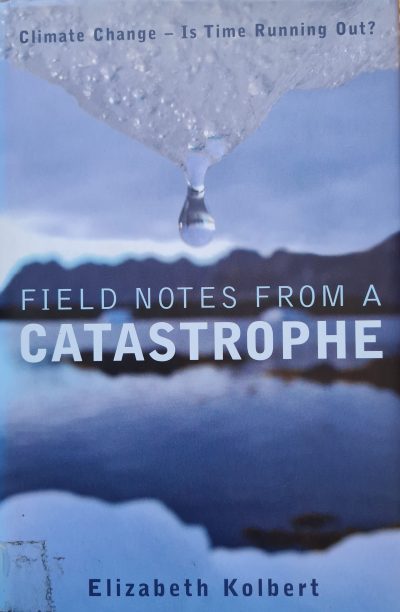
Kolbert,E. (2006) Field Notes From a Catastrophe: Climate Change – Is Time Running Out? London: Bloomsbury Press. 210pp.
Over the past 50 years, communicating the human causes and consequences of climate change has attracted writers of many different styles and motivations. There were the climate scientists who wrote their academic papers, some of whom tried their hand at writing for public audiences; there were the science journalists who covered the climate stories on their beat; there were novelists who began to see in climate change opportunities for new forms of story-telling; and there were activists and polemicists who wrote in order to persuade their audiences to change their ways or else to change society.
The American journalist Elizabeth Kolbert was none of these. First with the New York Times, and then since 1999 as an observer and commentator on the environment for The New Yorker magazine, Kolbert’s flair for writing was directed to cover many different news stories of general interest. Following her first book, ‘The Prophet of Love’, a series of portraits about the people who make New York City run, in 2006 she published ‘Field Notes From a Catastrophe: Climate Change – Is Time Running Out?’, the first of her several books about the changing environment. The book grew out of three award-winning essays she wrote for The New Yorker in the spring of 2005, and it had the goal, “to convey, as vividly as possible, the reality of global warming” [p.2]. In 40,000 words, she accomplishes this goal by travelling to places in the world where climate change is affecting the environment: Alaska, Greenland, the Netherlands, and Iceland.
As was common at the time for those trying to communicate the realities of a warming planet, ice—melting and disappearing ice—played a prominent role in her story. And there are several of the same ‘front-line witnesses’ that Mark Lynas had written about two years earlier. Her witnesses included an Ilulissat town councilman from Greenland, whom she reports as saying: “You don’t get big icebergs anymore … it’s very strange the last few years; you can see a lot of strange things” [p.2]. Kolbert also speaks with scientists about their findings and views and brings to attention some of the attempts of large corporations such as ExxonMobil to influence politicians and discredit scientists.
Following her Pulitzer Prize winning book in 2014, ‘The Sixth Extinction: An Unnatural History’, Kolbert prepared a new expanded edition of ‘Field Notes’ for Bloomsbury, published in 2015.[13] Kolbert added three new chapters for this second edition—on ocean acidification, the Alberta tar sands, and a Danish town that had gone carbon neutral—writing again with her distinctive direct and vivid prose.
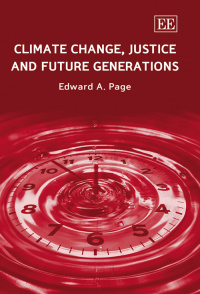
Page,E.A. (2006) Climate Change, Justice and Future Generations. Cheltenham: Edward Elgar. 224pp.
It was from the mid-2000s onwards that book length treatments of climate change and justice first began to appear. In an earlier short review in this series I drew attention to the first of these—Athanasiou and Baer’s ‘Dead Heat: Global Justice and Global Warming’ (2002)—but Ed Page’s ‘Climate Change, Justice and Future Generations’ published in 2006 was to be the one that really opened the flood gates. Page had gained his PhD from Warwick University in 1998, for a thesis titled ‘Intergenerational Justice and Climate Change’, and he began publishing articles about this topic the following year. After taking a number of lecturing positions in the UK and Sweden he returned to Warwick in 2006, where he remains to the present day.
Global climate change raises important questions of intergenerational justice and in his full-length 2006 book Page sought to answer a very specific question: What obligations do earlier generations of human beings owe to later generations in terms of controlling the extent of climate change and mitigating its effects? He tackles this specific question from the perspective of distributive justice and sustainable development. In contrast to other dimensions of justice—such as procedural or restorative justice—distributive justice is “the study of how benefits and burdens should be distributed across space and time” (p.3) or, put more succinctly, “who should get what and how much?” (p.51) The Kyoto Protocol came into force as Page was writing his book and discussions were beginning about what might follow-it, the subject of the later abortive negotiations at COP15 in Copenhagen in 2009. Page chose to ‘land’ his theoretical treatment of intergenerational justice by plumping for the ‘Contraction and Convergence’ (C&C) framework to guide negotiations, as had Athanasiou and Baer before him, grounded in the ideals of equality, priority and sufficiency.
In the October of the same year Page’s book appeared, the weighty—both literally and metaphorically—‘Stern Review’ was launched, it being the most comprehensive treatment of the costs and benefits of climate change mitigation to date. Central to Stern’s economics of climate change was the question of how to weight the interests of future generations when justifying actions in the present. It is perhaps Stern’s contentious analysis of economic discounting that best accounts for the post-2006 surge of books on climate justice and ethics, but Page’s early exploration of intergenerational justice still gathers between 30 and 40 citations a year, even though his favoured ideal of the C&C framework has long since died a death.
[1] Lenton,T. (2014) No place like home (Review of ‘A Rough Guide To The Future’, Allen Lane, 2014). Nature. 508: 41-42.
[2] Watts,J. (2024) The Many Lives of James Lovelock. Edinburgh: Cannogate.
[3] Contrast the account of this naming which Lovelock offers on p.188 with that supplied on pp.155-156 in Watts’ biography; ibid.
[4] Lovelock,J.E. (1979) Gaia: A New Look At Life on Earth. Oxford: Oxford University Press; Lovelock,J.E. (1988) The Ages of Gaia: A Biography of Our Living Earth. New York: Norton; Lovelock,J.E. (1991/2000) Gaia: The Practical Science of Planetary Medicine. Oxford: Oxford University Press; Lovelock,J.E. (2001) Homage to Gaia: The Life of an Independent Scientist. Oxford: Oxford University Press.
[5] Quote on p.14; also p.30, p.345 in: Hulme,M. (2009) Why We Disagree About Climate Change. Cambridge: Cambridge University Press.
[6] Lewis,M.W. (2007) The end is near. Issues in Science and Technology. 23(2): Winter.
[7] Toumin,C. (2006) James Lovelock and Gaia’s Revenge. openDemocracy: 29 March.
[8] Quoted on p.238 of Watts, 2024, op. cit.
[9] Lewis, 2007, op. cit.
[10] Mabey,R. (2006) ‘The Revenge of Gaia’ by James Lovelock, 29 January, The Sunday Times
[11] Lovelock,J.E. (2009) The Vanishing Face of Gaia: A Final Warning. London: Allen Lane; Lovelock,J.E. (2014) A Rough Ride to the Future. London: Penguin; Lovelock,J.E. and Appleyard,B. (2019) Novacene: The Coming Age of Hyperintelligence. London: Penguin.
[12] p.42, Lenton, 2014, op.cit.
[13] Kolbert,E. (2015) Field Notes From a Catastrophe: A Frontline Report on Climate Change. London: Bloomsbury Press. 320pp.