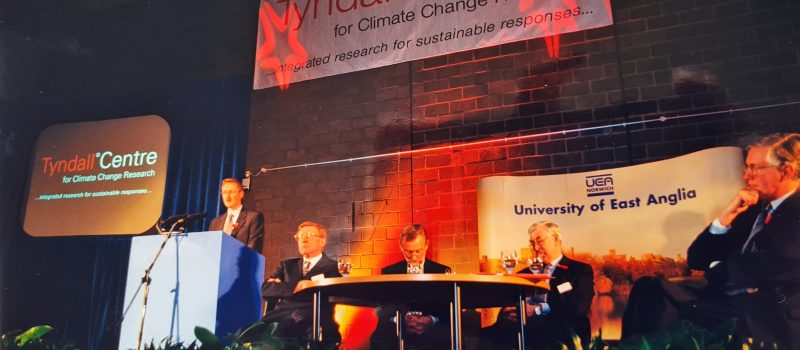
Twenty-five years ago today, on Thursday 9 November 2000, over 250 guests assembled at the University of East Anglia (UEA) to mark the official ‘opening’ of the newly-funded Tyndall Centre for Climate Change Research. The Centre was opened by the UK’s Environment Minister, Labour MP Michael Meacher (1939-2015), and took place in the middle of England’s wettest autumn in over 230 years of recorded data. The outcome of the United States’ Presidential election—either George Bush or Al Gore—hung in the balance and, the following week, the 6th COP to the Framework Convention on Climate Change was to begin in The Hague.
I remember the day well. I was awake by 5.30am in the morning and into the office before 7, while it was still dark. Adrenalin was running high, my emotions a mixture of excitement, pride and trepidation. There were plenty of things that could go wrong on the day—and many that, in the end, went right. For the next seven years, my primary responsibility would be to keep the Centre functioning and delivering. Today was to be just the start.
In fact it had already started. This launch event had been several months in the planning, ever since April when the UEA had been awarded the £10 million contract by three UK research councils to establish a new interdisciplinary and inter-university centre to research “solutions” to climate change. And as the appointed Executive Director, the previous six months had been a whirlwind: negotiating the details of the contract with our funders; establishing the operational basis of our collaboration with eight other UK institutions; appointing a research director (it was to be John Schellnhuber, then still the director of the Potsdam Institute); appointing a new team at Tyndall HQ to support my executive office; negotiating with UEA senior management for a suitable campus venue to host us (it turned out to the old sports hall); and designing a new Tyndall Centre brand and logo.
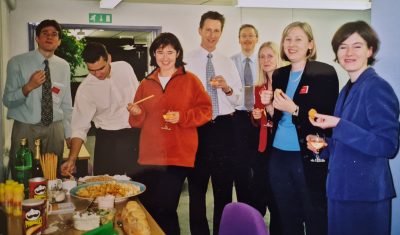
And amidst all of this activity there was the launch event to plan. Actually conducting some research would have to wait. By September I had my core team in place: Vanessa, Samantha, Simon, Gillian, and a group of early career researchers who moved over from the Climatic Research Unit to join me in the Tyndall Centre—John, Louise, Nicola, Suraje, Tim, Xianfu (see photo).
The press release which we sent out to all main UK media outlets on the Tuesday shows that we made full use of the floods in England and Wales and the impending COP6 in The Hague. The wet autumn had resulted in a series of severe floods affecting large parts of the country in the weeks leading up to the launch. The worst affected areas were Kent and Sussex during October and another Atlantic storm crossing the country on the Monday had dumped a lot of water over the west and north of England. It was now Shropshire, Worcestershire and Yorkshire which bore the brunt of the floods. Most of the main media outlets that week were therefore already attuned to climate.
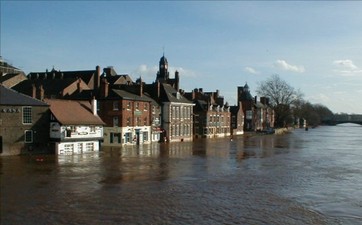
They were further prompted by the high level of Government attention being given to the flooding. Early in the week, John Prescott (1938-2024)—the Deputy Prime Minister and Secretary of State for the Environment, Transport and the Regions (DETR)—issued a media statement: “As you know, the Prime Minister and I have both visited several of the areas badly affected by the floods in recent days, and spoken both to residents and to those charged with dealing with the many emergencies that have occurred.” As well as visiting affected areas, Prescott announced new measures that the Government would be pursuing and opening a “Home Office emergency operation centre as necessary”. In particular, said Prescott, “we will look at the link between climate change and the severe floods we have had in recent years.”
Launching the Centre this day was also auspicious in that the following Monday, 13 November, COP6 was to begin at The Hague. The international Kyoto Protocol had been negotiated and agreed three years previously at COP3, but it was still not ratified. And now, with the result of Tuesday’s US Presidential Election in the balance—either George W Bush or Al Gore—it remained unclear who would be in the White House come January and what effect this would have on American ratification of the Protocol. We did not yet know of course, but the Hague COP would be suspended two weeks later by COP President Jan Pronk with no agreement being reached. It would recommence eight months later in Bonn, by which time Bush’s Republicans were in power.
As part of the programme for the day, I had organised an ‘Any Questions’ panel for the afternoon to discuss ‘COP6 and beyond: what role for research?’ The panel was chaired by the BBC News On-line environment correspondent Alex Kirby and the panellists included John Shepherd, the Tyndall lead scientist at one of our partner institutions, the Southampton Oceanography Centre, and Michael Grubb, energy economist at Imperial College and University of Cambridge another. (Michael had led the rival bid for the centre to ours, and graciously accepted the invitation). The late Saleemul Huq (1952-2013) from the Bangladesh Centre for Advanced Studies, Frances Maguire from Friends of the Earth, and Charlotte Grezo, a Senior Advisor at BP, made up the other members of the panel.
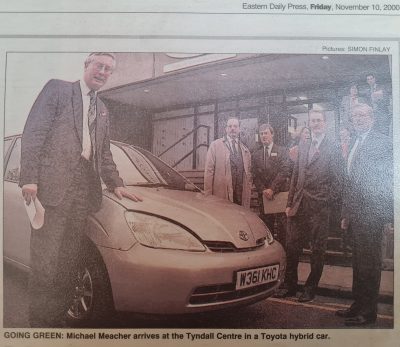
By then I was fairly exhausted and I retired to the back of the hall during the panel discussion to recuperate. The early start to the day, sorting out last minute arrangements, the meet-and-greet of guests, the VIP speeches and Meacher’s official opening of the Centre, and then, before the lunch break, my own speech … all of this had wiped me out. And over lunch, there were more people to glad-hand and we also had laid on a demonstration of the new Toyota Prius, the first commercial hybrid car recently launched onto the UK market and an early forerunner of today’s EVs (see photo). I had purchased one of these cars a few weeks earlier for my own private use, and earlier in the day had used it to drive Meacher, his senior civil servant, Henry Derwent, and our local MP, Charles Clarke, from Norwich railway station to UEA.
My 15-minute speech framed the challenge of climate change as one of risk management: What level of climatic change is tolerable? Can change be limited to that level? And, if not, what options were there to adapt? Earlier in the week I had published an essay along these lines, titled ‘Choice is All’, in New Scientist magazine. Reading back my speech and the New Scientist essay after these years, I can find the tentative origins of my book, ‘Why We Disagree About Climate Change’, published nine years later, shortly after I’d retired from running the Tyndall Centre.
But now, with the Centre launched, the guests dispersed, and the cameras put away, the hard but rewarding task of delivering on our promises was to begin.
© Mike Hulme, 9 November 2025